Well, here we are. #LAMBAA

I created this anti-MAGA hat on Zazzle over 5 years ago, on July 4, 2019. After the 2024 election, it’s time to brush it off and debut it again.

The reference, of course, is to Langston Hughes’ classic poem, “Let America Be America Again” (1935), which I commend to all of you to read in its entirety, preferably out loud.

Let America be America again.
Let it be the dream it used to be.
Let it be the pioneer on the plain
Seeking a home where he himself is free.
(America never was America to me.)

– Langston Hughes, 1901–1967

Kamala 2024: #lotusforpotus

Tomorrow is Election Day 2024. Today, as sort of a talisman, I’m wearing the shirt I created over the summer. I’ll be voting in person around 7am tomorrow, so as I can’t wear it to the polls, today it is.

And of course I should have posted this here months ago, but here we are: Order yours on Zazzle at https://www.zazzle.com/kamala_lotus_2024_t_shirt-256793125677123295?rf=238246111243318061

One more fun thing, I finally remembered a graphic I created several years back for my BFF who is a charter member of the 47 Society, for fans of “the quintessential random number of the universe”. Let’s hope this is a good omen, too.

Free printable Passover cards

I made a new Passover card design this year that I’ve been thinking about for a little while. It’s a seder plate design, but instead of the traditional Hebrew item designations in the center, I chose a word expressing the symbolism of each item.

  • Karpas – Greens – Renewal
  • Zeroah – Shankbone – Strength
  • Maror – Bitter Herb – Suffering
  • Chazeret – Lettuce – Bitterness
  • Charoset – Mortar – Building
  • Beitzah – Egg – Rebirth
Continue reading →

Esther: For such a time as this

Tonight and tomorrow is Purim, the holiday celebrating the deliverance of the Jews of Persia from the evil machinations of the King’s vizier. There are four central mitzvot (commandments) of this holiday, but the most iconic one is the reading of the book of Esther, known as the Megillah (Scroll).

Megillat Esther has a special trope (melody) that I’ve never learned, but this year, we’re all reading out of books at home via Zoom, and our rabbi asked me if I would take on reading chapter 4. This chapter, as it happens, has several verses that are read in the the trope used for the book of Eicha (Lamentations) on Tisha B’Av, which I learned a couple years ago, so I figured that was a sign that I should step up.

This chapter also includes a verse that has always resonated with me. Queen Esther (in the palace) and her uncle Mordechai (protesting out in the town square) exchange a series of messages via Hatach, the chamberlain, about the looming crisis for the Jews. Mordechai implores Esther to use her privileged status and access to the king to intervene for her people, saying, “Do not think that because you are in the king’s house you alone of all the Jews will escape. For if you remain silent at this time, relief and deliverance for the Jews will arise from another place, but you and your father’s family will perish. And who knows but that you have come to power for such a time as this?” (Esther 4:13-14)

For this image, I wanted a watercolor wash background, and since it was surprisingly hard to find a suitable free version, I created my own in Photoshop. Drop me an email or a comment if you want a pointer to the exact brush settings. Then I darkened it up to improve the contrast.

I saved my images as grayscale TIFFs so I could apply the magenta color to them in InDesign, but WordPress is making me post them here as JPEGs. Do with them what you will – these backgrounds are free for personal or commercial use – but please find a way to link back to schultzyakovetz.com if you want to maintain good Internet karma.

The script font I chose is Selima, a lovely free brush script created by Jroh Creative. The block face is classic Goudy Old Style and the Hebrew is the beautiful Escritura Hebrew Demibold by Ricardo Santos.

May we all use our power and privilege to do good anytime we find ourselves in a position to do so. Who knows but that we were placed there for just such a time?

Now, off to finish cramming that reading! Purim sameach!

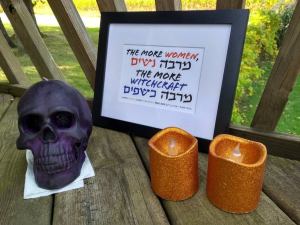
“The more women, the more witchcraft”

“[Rabbi Hillel] used to say: The more flesh, the more worms; The more property, the more anxiety; The more wives [nashim = women], the more witchcraft; The more female slaves, the more lewdness; The more slaves, the more robbery; [But] the more Torah, the more life; The more sitting [in the company of scholars], the more wisdom; The more counsel, the more understanding; The more charity, the more peace.”
– Pirkei Avot 2:7

Marbeh nashim, marbeh cheshafim. Who doesn’t love a good out-of-context quote from the Talmud? The first time I saw this aphorism attributed to Rabbi Hillel, I thought “that can’t be real!” and ran to verify it, but here it is – just in time for October.

I’m pretty sure this passage was intended to address the concept of intentional simplicity, and how our priorities shape our lives. However, it’s also clearly directed only at men; it mentions women twice, but both times only in their roles as objects possessed by men: nashim (wives) and shefachot (handmaids). Nashim doesn’t just mean “wife”, though, it is the plural of isha and means “women” generally, so let’s run with the enjoyable surface reading here.

I created this More Women More Witchcraft design as a smaller 5×7 piece to fit comfortably into a collection, whether it’s your Halloween decor or a year-round Jewitch display.  If you’d like it scaled differently, you can always request a custom order for a print in your preferred size.

Etsy listing

Marbeh nashim, marbeh cheshafim: “The more women, the more witchcraft”. – Rabbi Hillel, Pirkei Avot 2:7.

Tzedek, tzedek tirdof: The pursuit of justice

When I receive a request for a custom design piece, it is often a Bible verse or other Jewish text that would make a good addition to my overall portfolio. In those cases, I add a custom design charge of $20 to the regular art pricing, which entitles the client to choose their design direction and request a complimentary round of revisions (I usually throw in a second and even a third round for free). However, the alternate drafts along the way usually result in work that I can make available for general sale.

Back in July, I had a recent Etsy customer come back to me and say “Would you consider making something for Deuteronomy 16:20, ‘Justice, justice you shall pursue’?” Of course, that verse has been on my list of ideas for a long time, so I jumped at the opportunity to work something up.

Continue reading →

Rosh Hashanah 2020: Letterform Apple

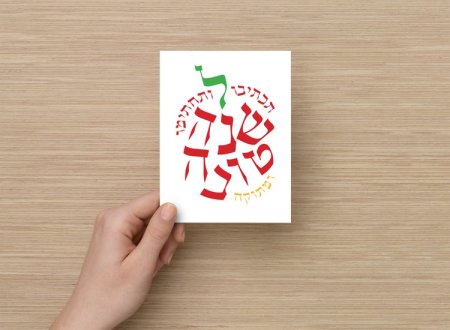
I created this design back in 2016, and have had it up on Zazzle ever since, but have rarely or never gotten any orders for it. However, a few weeks ago I got a notice that someone had ordered several copies (l’shanah tovah, friend!), and that reminded me I had never actually used it myself. So I decided to dust it off for 2020, both to send as my personal card and to post for sale on Etsy.

One of the most popular Jewish New Year customs involves eating apple slices dipped in honey, sometimes after saying a special prayer, signifying the hope that the coming year will be sweet. The apple design on this Rosh Hashanah card is formed out of the phrase “Tikatevu v’teichateimu l’shanah tovah u’metukah”: May you be inscribed and sealed for a good and sweet new year. The word “metukah” (sweet) is set off in yellow to represent a drip of honey.

This is a small A2-size notecard (folded size approximately 5.5″x4.25″). Unprinted white A2 envelopes are included.

Click through to view on Etsy.

Clean hands and a pure heart, or, Greetings from Coronaland

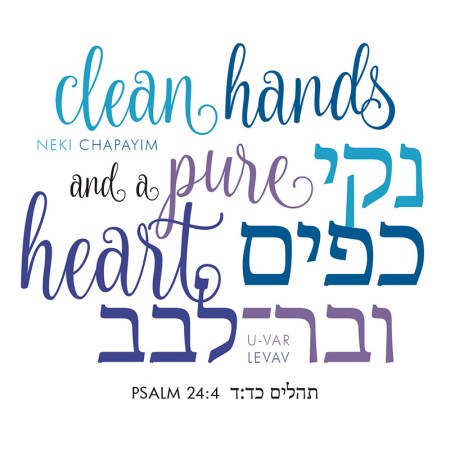
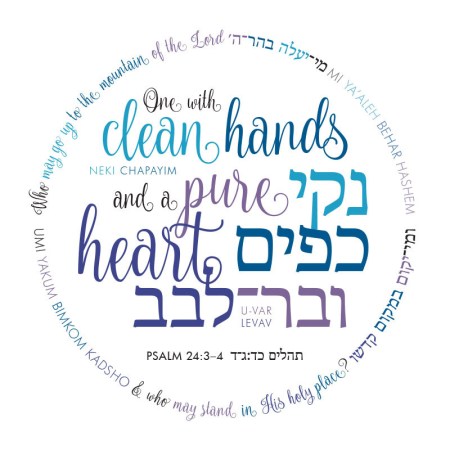
In Jewish tradition, Psalm 24 is recited as the Psalm of the Day (“as the Levites used to recite in the temple”) for Sundays, and is also recited when putting away the Torah at any morning service that is not on Shabbat. Verse 4, though, is probably one of your mom’s or grandma’s favorite proverbs just on general principles:

“Who may go up to the mountain of the Lord? And who may stand in His holy place? One with clean hands and a pure heart.”

Psalm 24:3-4

I’ve always liked this psalm, and after playing with this particular verse for a while, I released the design below on Etsy exactly one year ago today. Click through the images to see the listings.

Verse 4a by itself
Framed by Verse 3 in a circular format.

Needless to say, however, with the sudden cultural emphasis on frequent and effective handwashing, this verse has been much on my mind in the last month. I venture to suggest that singing through the first 4 verses of the psalm is as good a way as any to time your 20-second handwashing.

L’David mizmor:
LaShem ha-aretz u’meloah, teivel v-yoshvei vah;

Ki hu al ha-yamim yesadah, v-al neharot yechoneneha.

Mi ya’aleh b’har HaShem, u-mi yakum bimkom kadsho?

Neki chapayim u-var levav, asher lo nasa lashav nafshi,
v-lo nishba l-mirma.

(Note that Jewish tradition discourages reciting prayers or blessings, using the name of God, or speaking of “matters of Torah” while in the bathroom. However, this isn’t strictly a prayer nor from the Torah, and we elide the name of God anyway in casual use, so I personally think it’s within bounds. As always, consult your local rabbi.)

Bishvili Nivra HaOlam, or, The two pockets

In October of 2018, an Etsy customer commissioned from me a design of the quotation Bishvili nivra ha-olam: “The world was created for me”.

This phrase is a quote from the Talmud (Sanhedrin 37B), but it is most famously incorporated into a Chassidic story about Rabbi Simcha Bunim of Peshischa (the Yiddish name for the town of Przysucha, Poland).

Rabbi Simcha Bunim teaches: Every person should have two pockets. In one pocket should be a piece of paper saying: “I am only dust and ashes.” When one is feeling too proud, reach into this pocket and take out this paper and read it. In the other pocket should be a piece of paper saying: “For my sake was the world created.” When one is feeling disheartened and lowly, reach into this pocket and take this paper out and read it. We are each the joining of two worlds. We are fashioned from clay, but our spirit is the breath of Adonai.
—Martin Buber, Tales of The Hasidim Later Masters, pp. 249-50

At the time of the original commission, it struck me that I ought to create a two-sided wallet card with one saying on each side.

Zazzle annually offers its Pro members (ProDesigners) a free batch of business cards (FYI!). So when it came time to order this year’s set, I finally sat down and designed the other side.

The cards arrived last Thursday and I’m quite pleased with them!

At that point, I also realized that by a happy coincidence, that week’s Torah portion was Vayera, the source of the “dust and ashes” quotation. It occurs in Genesis 18:27 when Abraham is bargaining with God over Sodom and Gomorrah:

כז  וַיַּעַן אַבְרָהָם, וַיֹּאמַר:  הִנֵּה-נָא הוֹאַלְתִּי לְדַבֵּר אֶל-אֲדֹנָי, וְאָנֹכִי עָפָר וָאֵפֶר. 27 And Abraham answered and said: ‘Behold now, I have taken upon me to speak unto the LORD, who am but dust and ashes.
כח  אוּלַי יַחְסְרוּן חֲמִשִּׁים הַצַּדִּיקִם, חֲמִשָּׁה–הֲתַשְׁחִית בַּחֲמִשָּׁה, אֶת-כָּל-הָעִיר; וַיֹּאמֶר, לֹא אַשְׁחִית, אִם-אֶמְצָא שָׁם, אַרְבָּעִים וַחֲמִשָּׁה. 28 Peradventure there shall lack five of the fifty righteous; wilt Thou destroy all the city for lack of five?’ And He said: ‘I will not destroy it, if I find there forty and five.’

—Genesis Chapter 18

Granted, there’s nothing like entering a battle of wits with the Eternal Creator to make a person mindful of their own base humanity. But the point is, maybe Abraham would also have benefited from keeping one of these two-sided cards in his pocket. After all, in a very real sense, the world was also created for him.


Further reading:


Follow me on Instagram!

The way I originally joined Instagram, personally, was quite by accident. Since I have a gmail account under my maiden name, I get a lot of “doppelganger” email for other users named Erica Schultz (who apparently can’t remember or type their own email addresses correctly, or else other people can’t). In June of 2015, I got an email from Instagram addressed to the username “aleishaphippen4p” with a link to reset my password. I ignored it at the time. But in July of 2016, I got another reset link for the same username at my email address, and I thought, why not?

Note that these types of emails are frequently phishing attacks, but I checked the original message and all its headers and URLs, and everything seemed legitimately linked back to Instagram.com. So I reset the password associated with my email. Then, since Instagram lets you do this, I simply changed the username to @eschultz72. Easy-peasy.

So I guess, thanks, Aleisha, whoever you are.

I used it very sporadically. (If you want more pictures of food, sunsets, performative Judaism, and my toddler-now-preschooler, that’s the place to follow me.) But fast forward a couple years and I’m now working for the Jewish Federation of Northwest Indiana as communications director, including social media responsibilities. So this fall when they said “we need to get on Instagram!” I had to get up to speed! Check them out at @jewishnwindiana.

While I was at it, I decided that my Judaica line also needed a dedicated Instagram. I had set up a Facebook page for Schultz Yakovetz Judaica in April of 2016 (admittedly as a Gen-Xer I’m much more native on FB than on Instagram). But it struck me that I could use Facebook to showcase new designs (and link to product listings) and still take advantage of Instagram to present more real-life product shots and behind-the-scenes takes. Which brings me to today and the newly minted @schultzyakovetz. You know what to do. :-D