This weekend we made it through the beginning of Pesach, a.k.a. Passover, complete with 2 seders and a requisite (in our house) viewing of The Prince of Egypt. I could and probably should write a whole post on the topic of The Prince of Egypt, the star-studded 1998 animated masterpiece of DreamWorks SKG – otherwise known as Spielberg, Katzenberg and Geffen, i.e., the Jew Crew. For now, suffice it to say that it’s pretty easy to distinguish Old Testament stories being retold by Christians from Hebrew Bible stories being retold by Jews, and this one scores high on the authenticity scale.
Anyway, Passover. While I was hoping to have some newer product listings to share by now, I’m bringing you a Passover card from the backlist (created in 2023) since I don’t think I ever wrote about it here.
This exuberant pastel design makes use of one of the best-known passages in the Passover Seder: Ilu hotzianu mi-Mitzrayim, Dayenu! If God had merely brought us out of Egypt, that would have been enough for us.
Inside reads “Wishing you a joyful Passover” in English and “Chag kasher v’sameach” (the traditional Passover greeting) in Hebrew.
Passover is a week away? Already?? It always seems to come as a surprise, but not if you’ve been paying attention to the subtle calendar clues in our tradition.
The two months leading up to Passover include four special Shabbats that include additional maftir Torah readings from a second Torah scroll:
Shabbat Shekalim, the Shabbat immediately prior to (or falling on) Rosh Chodesh Adar; the maftir reading, Exodus 30:11-16, describes the half-shekel census taken in the wilderness.
Shabbat Zakhor, the Shabbat before Purim; the maftir reading, Deuteronomy 25:17-19, commands us to remember (zakhor) the treachery of Amalek and to simultaneously blot out his name from our memory, as we will shortly do on Purim.
Shabbat Parah, one to two weeks prior to Rosh Chodesh Nisan; the maftir reading, Numbers 19:1-22, fondly known as the “Holy Cow” Parshah, discusses the arcane ritual of the red heifer (parah adumah).
Shabbat HaChodesh, the Shabbat immediately prior to (or falling on) Rosh Chodesh Nisan; the maftir reading, Exodus 12:1-20, starts with the line “This month (ha-chodesh ha-zeh) shall be for you the beginning of the months, it shall be for you the first of the months of the year.” This is when you know you have only 2+ weeks left until Passover and it’s time to start screaming… er, cleaning. This was a week ago yesterday. (Yesterday was plain old Parshat Vayikra, the first parshah in the book of Leviticus.)
This coming Shabbat, the one that falls immediately prior to Passover, isn’t one of those four, but it still gets a special haftarah portion and hence a special name: Shabbat HaGadol, literally “The Great Shabbat”, or as my Tremont St. Shul crowd liked to say, “The Big Shabbos”. It’s not super common for Shabbat HaGadol to literally fall on the eve of Passover, but anytime you have a Saturday night first seder, you’ve got yourself a Shabbat HaGadol double header.
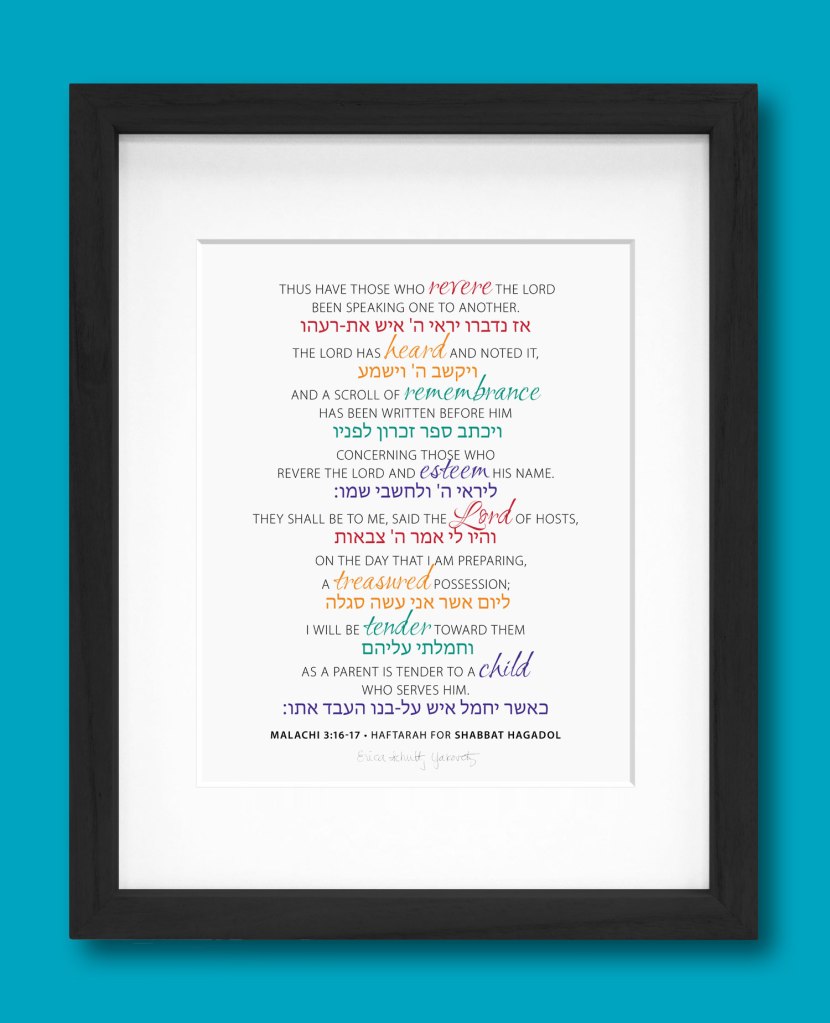
The Haftarah for Shabbat HaGadol is Malachi 3:4-24, and the day takes its name from verse 23: “Lo, I will send the prophet Elijah to you before the coming of the awesome (ha-gadol), fearful day of the Lord”. I was commissioned some years ago to create a piece from this haftarah as a bat mitzvah gift. The actual eponymous verse didn’t grab me, and it took a little digging to find a passage that would be both uplifting and memorable, but I settled on verses 16-17:
Thus have those who revere the Lord been speaking one to another. The Lord has heard and noted it, and a scroll of remembrance has been written before Him concerning those who revere the Lord and esteem His name. They shall be to me, said the Lord of Hosts, on the day that I am preparing, a treasured possession; I will be tender toward them as a parent is tender to a child who serves him. —Malachi 3:16-17
Interestingly, this week’s Torah portion is Tzav, the second parshah in the book of Vayikra (Leviticus). The designated haftarah portion officially paired with Tzav is from the book of Jeremiah (7:21-8:3, 9:22-23). However, because Tzav so frequently falls out on one of the aforementioned five special Shabbats, the “standard” haftarah is very rarely read. It was read in 2022, but it won’t be read again until 2043! I have an art piece for this as well:
Thus says the Lord: Let not the wise glory in their wisdom; and let not the strong glory in their strength; let not the wealthy glory in their wealth. But only in this should they glory: in knowing and understanding Me, that I am the Lord who does kindness, justice and righteousness in the land, for in these I delight, says the Lord. —Jeremiah 9:23-24
Let’s not forget to bring that energy into this week, as well.
When I started my Etsy Judaica shop as an unemployed newlywed in 2014, I had no idea that “miniature books” would eventually be an entire category in my product line. But in 2017, I got a message from a past buyer: “Do you have a set of Tanya or the Talmud in 1:12 scale please? Any other Judaica?”
I didn’t, but I love Jewish books and I have always loved miniatures, so I figured, why not me?
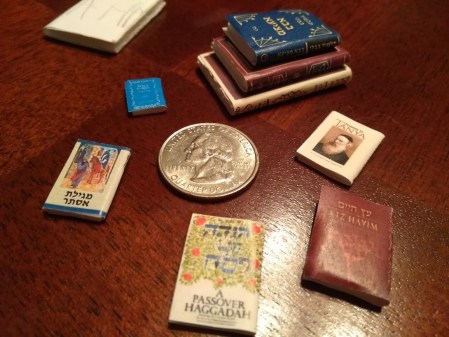
It took a couple years for me to work out the specifics, but I ended up creating over 80 pieces of 12+ different books for her, including multiple sets of Talmud volumes, a set of Midrash Rabbah, a JPS Tanakh, an Etz Hayim Humash (see also: Eitz Chayim Chumash), Passover haggadahs, the Five Megillot, B’Kol Echad benchers, and, yes, a five-volume set of Tanya (not yet posted for general sale, but if you’re looking for one, hit me up).
A library of Judaica in the palm of my hand.
Miniature books shown with a U.S. quarter for scale.
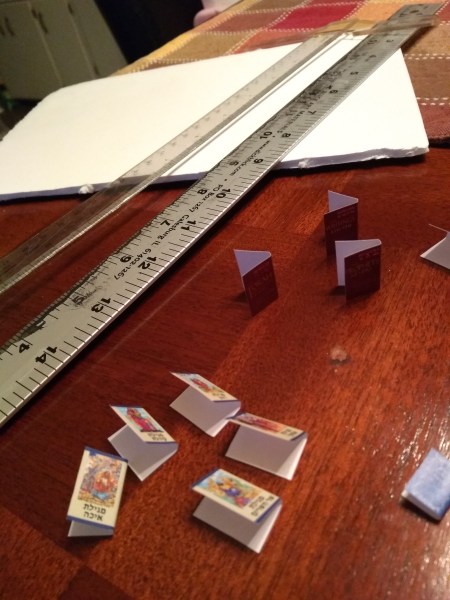
Cutting the foamcore blocks for the centers.
Paper covers awaiting their book blocks.
Miniature Haggadahs.
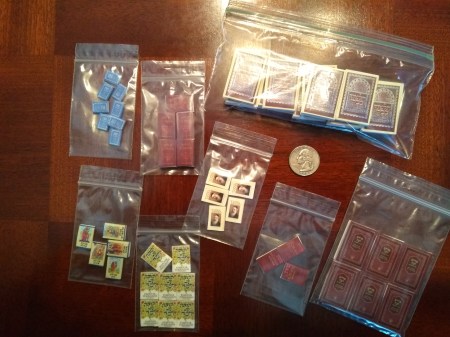
Sets of miniature books packaged for shipping.
Yes, I bought a dollhouse bookcase to stage the books in.
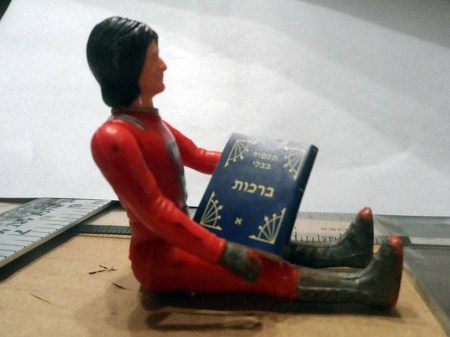
Rabbi Mork from Ork (the Orker Rav) studying Tractate Brachot.
Today and tomorrow begins the Hebrew month of Adar, of which the Talmud (Ta’anit 29a) says, “When Adar enters, joy increases.” The primary reason for this joyfulness is that it contains the holiday of Purim, when the Jews of Persia in the 5th century B.C.E. were almost destroyed by an evil prime minister manipulating a feckless king (nope, not resonant at all), but were saved by the hand of God working through a courageous young Jewish woman. For more about Adar and Purim, I commend you to one of my favorite websites, Jewish Heritage Online Magazine, a rich repository of insights on Jewish cultural themes.
For myself, I have two Purim-related art projects to share with you.
I made a new Passover card design this year that I’ve been thinking about for a little while. It’s a seder plate design, but instead of the traditional Hebrew item designations in the center, I chose a word expressing the symbolism of each item.
(No, it’s not a new Harry Potter knockoff series, although couldn’t you just see that?)
tl;dr It’s the New Year of the Trees, so join me tonight at 6pm CST / 7pm EST for a virtual Tu B’Shvat seder with the Tremont St. Shul. Email or PM me for the Zoom info. BYOF – Bring Your Own Fruit!
Some 20 years ago, I was running the 20s&30s young adult group at my synagogue, Temple Beth Shalom of Cambridge (MA), a.k.a. the Tremont Street Shul. I believe the first time we ran a formal Tu B’Shvat seder was in 2001, because I stayed up all night cobbling together a seder packet, which you can still download today from my website. It was a popular event year after year, with fruit platters, red and white wine, candles and eucalyptus branches on the tables. I’ve always had a fondness since then for Tu B’Shevat, the New Year of the Trees.
In 2020 and 2021, as we all became Zoom-based lifeforms in the wake of the Covid pandemic, synagogues (like most organizations) began searching for ways to build virtual community. In the spring of 2021, TBS had the great idea to run a virtual Tu Bishvat program and send out fruit baskets to their members, and they asked me to run an abridged version of the seder. It was really an honor to participate and a joy to see so many of my old chevre.
It went over well enough that they’re doing it again for 2022, tonight at 7pm EST (6pm CST). It’s free and open to the public, so contact me if you’d like the Zoom information, or sign up here.
Below are my notes from last year, since I had my script mostly written out. This year we’ll try to make it a little more focused and in-depth, but this is good background for anyone.
In January of 2021, I was tagged by some friends into a Facebook thread from the illustrious Delia Sherman, on behalf of a friend looking for a graphic designer to help produce a self-published book with some Hebrew in it. Since that’s totally my niche, I was pleased when the co-author reached out to me the next day for some more information. That was my introduction to yoga teacher Sharon Epstein, her rabbi Tara Feldman, and their book project, which would become a labor of love for me as well: Into a Jewish Holiday Year with Yoga: A Workbook and Guided Journey for Body, Mind, and Soul (2021; ISBN 979-8-9850271-0-5; USD $19.95).
The ikar, or kernel, of the book is that these two delightful and insightful women have teamed up to structure a yoga experience around the Jewish holiday cycle. For each of 12 holidays, they had put together some basic introductory context, then drawn out a deep underlying conceptual theme, and matched it with a set of yoga poses to literally embody that theme. They also provided a guided meditation and some journaling prompts to round out the internal experience of each holiday.
Mind you, I have spent a total of about 2 hours on a yoga mat in my life, but I have a visceral appreciation for the rhythms of the Jewish calendar. We are souls and we are bodies. Bringing together the spiritual and the somatic brings depth to both perceptions. It was a real gift to get to be a part of this project and help Sharon and Tara activate its full potential.
Tonight and tomorrow is Purim, the holiday celebrating the deliverance of the Jews of Persia from the evil machinations of the King’s vizier. There are four central mitzvot (commandments) of this holiday, but the most iconic one is the reading of the book of Esther, known as the Megillah (Scroll).
Megillat Esther has a special trope (melody) that I’ve never learned, but this year, we’re all reading out of books at home via Zoom, and our rabbi asked me if I would take on reading chapter 4. This chapter, as it happens, has several verses that are read in the the trope used for the book of Eicha (Lamentations) on Tisha B’Av, which I learned a couple years ago, so I figured that was a sign that I should step up.
This chapter also includes a verse that has always resonated with me. Queen Esther (in the palace) and her uncle Mordechai (protesting out in the town square) exchange a series of messages via Hatach, the chamberlain, about the looming crisis for the Jews. Mordechai implores Esther to use her privileged status and access to the king to intervene for her people, saying, “Do not think that because you are in the king’s house you alone of all the Jews will escape. For if you remain silent at this time, relief and deliverance for the Jews will arise from another place, but you and your father’s family will perish. And who knows but that you have come to power for such a time as this?” (Esther 4:13-14)
For this image, I wanted a watercolor wash background, and since it was surprisingly hard to find a suitable free version, I created my own in Photoshop. Drop me an email or a comment if you want a pointer to the exact brush settings. Then I darkened it up to improve the contrast.
I saved my images as grayscale TIFFs so I could apply the magenta color to them in InDesign, but WordPress is making me post them here as JPEGs. Do with them what you will – these backgrounds are free for personal or commercial use – but please find a way to link back to schultzyakovetz.com if you want to maintain good Internet karma.
May we all use our power and privilege to do good anytime we find ourselves in a position to do so. Who knows but that we were placed there for just such a time?
Now, off to finish cramming that reading! Purim sameach!
Here in Northwest Indiana, my kindergartener is the only Jewish kid in her class. As many of you have no doubt experienced, that makes her the go-to for educating the class on Jewish holidays – even at age 5.
Yesterday, her teacher asked if she would read a book about Chanukah to the class this morning (fully remote of course). No problem, we thought; we have several wonderful books on hand, we’ll pick one out. However, looking them over at bedtime quickly made it clear that there wasn’t one among them that she could read fluently by herself.
So what does Mama do? Get up Friday morning and put one together! I tried to approach it through the lens of what she would tell the class about Chanukah from her perspective.
I made it 8 pages to fit on 2 letter-sized sheets. Adobe’s Acrobat Reader should let you print this on the “Booklet” setting to come out right for folding, but just in case your printer software isn’t up to the task, I also made a PDF with the pages already doubled up (you still have to print it double-sided though).
Little one was very pleased and read it perfectly on the first try. Note that she is (of course) a fairly precocious reader for Grade K, but while I’m no literacy specialist, it would probably work well for any early readers.
“[Rabbi Hillel] used to say: The more flesh, the more worms; The more property, the more anxiety; The more wives [nashim = women], the more witchcraft; The more female slaves, the more lewdness; The more slaves, the more robbery; [But] the more Torah, the more life; The more sitting [in the company of scholars], the more wisdom; The more counsel, the more understanding; The more charity, the more peace.” – Pirkei Avot 2:7
Marbeh nashim, marbeh cheshafim. Who doesn’t love a good out-of-context quote from the Talmud? The first time I saw this aphorism attributed to Rabbi Hillel, I thought “that can’t be real!” and ran to verify it, but here it is – just in time for October.
I’m pretty sure this passage was intended to address the concept of intentional simplicity, and how our priorities shape our lives. However, it’s also clearly directed only at men; it mentions women twice, but both times only in their roles as objects possessed by men: nashim (wives) and shefachot (handmaids). Nashim doesn’t just mean “wife”, though, it is the plural of isha and means “women” generally, so let’s run with the enjoyable surface reading here.
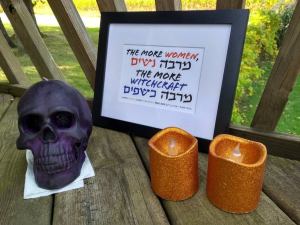
I created this More Women More Witchcraft design as a smaller 5×7 piece to fit comfortably into a collection, whether it’s your Halloween decor or a year-round Jewitch display. If you’d like it scaled differently, you can always request a custom order for a print in your preferred size.
Marbeh nashim, marbeh cheshafim: “The more women, the more witchcraft”. – Rabbi Hillel, Pirkei Avot 2:7.











 Erica Schultz Yakovetz