Hebrew temporary tattoos

With Passover behind us, next week begins the month of Iyyar, and that means we’re already on the next set of holidays and observances, known in Jewish day school circles (and elsewhere) as “the Yoms”:

  • Yom HaShoah, Holocaust Remembrance Day (27th of Nisan, this year falling on April 24, yesterday)
  • Yom HaZikaron, Israel’s Memorial Day (4th of Iyyar, this year falling on April 30)
  • Yom HaAtzma’ut, Israel’s Independence Day (5th of Iyyar, this year falling on May 1)

So, on the topic of your community’s upcoming Yom HaAtzma’ut celebration, I’m going to showcase yet another item I never would have guessed would become a cornerstone of my Etsy shop… custom printed temporary tattoos in Hebrew.

In 2022, I had already been creating tattoo designs in Hebrew for several years, mostly as custom work, and I posted a couple of successful designs in my Etsy shop as digital downloads only. Then in 2023, after fielding multiple requests, I started offering a Custom Hebrew Tattoo Design as a digital product, where I would translate your desired phrase and supply it in your choice of typeface, and that was that for a while.
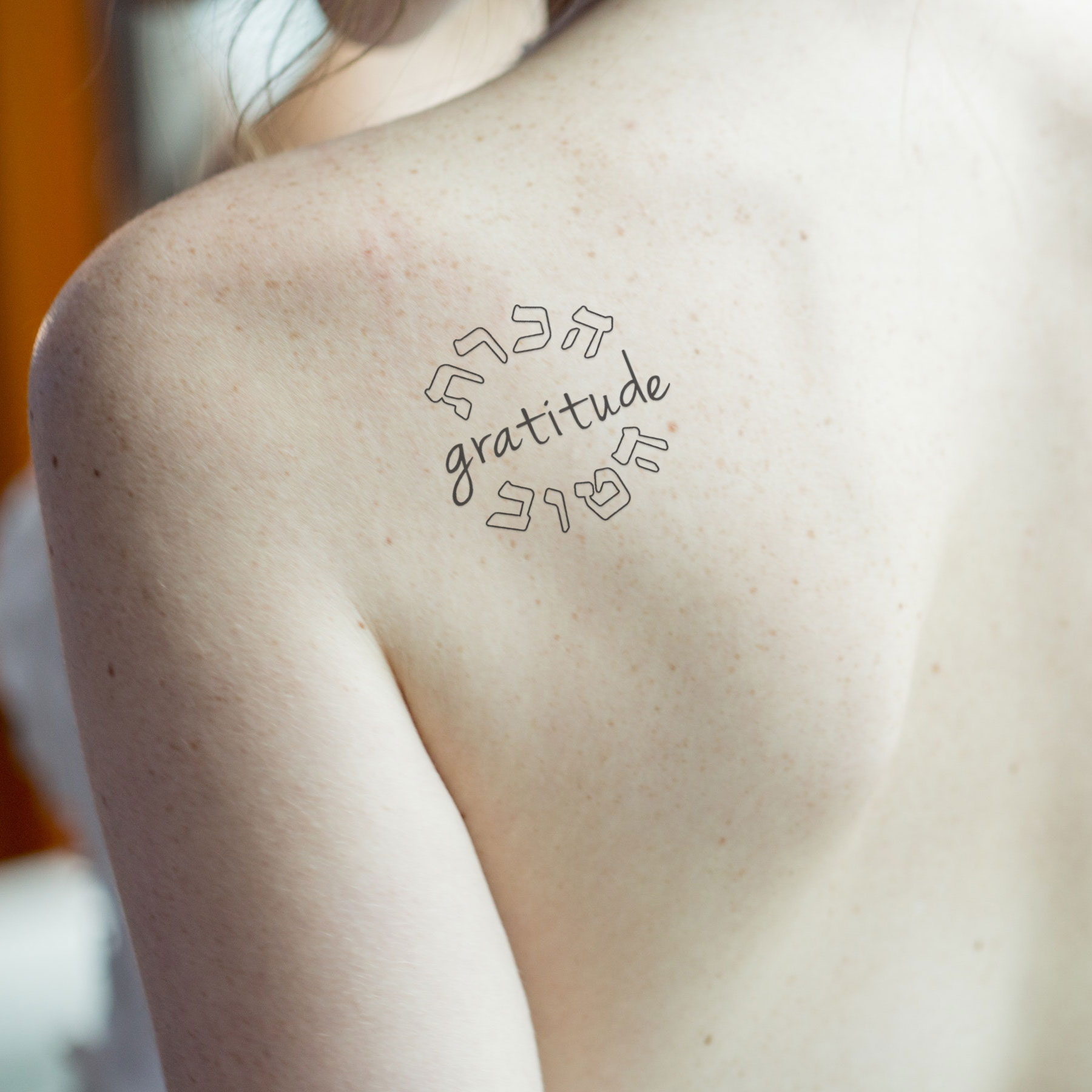
Then one week, I had two different buyers say “Gee I thought I would receive a temporary decal, how am I supposed to get this on my body?” I’m like “er, with needles and ink, I assumed?” but then I thought, well, is this something I can offer?

So I looked into it, and it turns out you can buy laser-printable tattoo paper on Amazon. I bought a couple different brands to test out, but they all seem to be essentially the same: a sheet of paper that you print on, and a sheet of plastic-backed adhesive film that you peel off and apply to the decal paper.

Tips and tricks for creating the decals:

  • Important note: your desired image has to be mirrored, meaning flipped horizontally, before you print it! I’ve wasted many sheets by forgetting this crucial step.
  • I cut the sheets in half before I print them. This makes it easier to print small batches without wasting any space, but it also makes the adhesive sheet easier to apply without skewing or flopping around.
  • Print-it-yourself tattoo paper doesn’t come out exactly like the temp tattoo decals you can buy at Party City or whatnot. You can see the clear film of the adhesive around the edge of the printing. It’s best to trim the decal with scissors fairly close to the design before you apply it. After application, you can dip a cotton swab in rubbing alcohol and gently “erase” the edges; this is also good maintenance once it begins to look dingy around the edges after a few days.

Directions for application (this is what I send to buyers with my decal orders):

  1. Peel off the clear backing.
  2. Place the tattoo image face down on your skin in the desired position.
  3. Moisten the backing paper of the tattoo with a wet cloth or sponge until it is fully saturated.
  4. Apply gentle pressure for 30 seconds.
  5. Slide the backing paper off slowly.
  6. Rub the finished tattoo with your finger to improve adhesion to the skin.

Your tattoo may last up to a week with normal bathing. To remove sooner, wipe with rubbing alcohol on a cotton ball or tissue. Don’t scrub it off, it isn’t necessary and just irritates your skin. (obligatory Jewish mom warning)

Besides the custom Hebrew temporary tattoos, I have added a number of stock phrases for sale as either digital downloads or temp tattoo decals, since they are commonly requested:

One of the interesting things about this venture is that I get as many Christian customers as Jewish ones. Most people don’t identify themselves outright as one or the other, and I don’t make my assumptions based on their names (although sometimes the names are pretty unambiguous!), but rather by the wording they use and the phrases they ask for. If you ask for “tikkun olam”, “zachor” or “l’dor va-dor” – pretty obviously Jewish or Jewish-adjacent. If you ask for “family”, “freedom”, “light the darkness”, or “never forget” – 99% likely Jewish. If you ask for “shepherd”, “redeemed”, or “daughter of the king” – Christian. I’ve also had a number of buyers identify themselves to me as Christians but fellow travelers supporting Israel or finding meaning in Hebrew texts, and I’m all for that. Either way, friends, I will do my best to help you out!

PS: It is commonly known, or at least asserted, that Jewish law prohibits tattooing. The halachic status is actually a bit complex, so I urge you to consult your local rabbi if you have questions. I’m not giving or denying permission to anyone, I’m just creating artwork for people to use as they see fit. However, as far as I know there are no Jewish religious restrictions on the use of temporary tattoo decals, so order away on these!

PPS: Boston friends, as you read this I’m getting on an airplane to attend a bar mitzvah in Cambridge for Parshat Shmini… either I’ll see you there, or please let me know where else I can see you!

Book project launch: Into a Jewish Holiday Year with Yoga

In January of 2021, I was tagged by some friends into a Facebook thread from the illustrious Delia Sherman, on behalf of a friend looking for a graphic designer to help produce a self-published book with some Hebrew in it. Since that’s totally my niche, I was pleased when the co-author reached out to me the next day for some more information. That was my introduction to yoga teacher Sharon Epstein, her rabbi Tara Feldman, and their book project, which would become a labor of love for me as well: Into a Jewish Holiday Year with Yoga: A Workbook and Guided Journey for Body, Mind, and Soul (2021; ISBN 979-8-9850271-0-5; USD $19.95).

The ikar, or kernel, of the book is that these two delightful and insightful women have teamed up to structure a yoga experience around the Jewish holiday cycle. For each of 12 holidays, they had put together some basic introductory context, then drawn out a deep underlying conceptual theme, and matched it with a set of yoga poses to literally embody that theme. They also provided a guided meditation and some journaling prompts to round out the internal experience of each holiday.

Mind you, I have spent a total of about 2 hours on a yoga mat in my life, but I have a visceral appreciation for the rhythms of the Jewish calendar. We are souls and we are bodies. Bringing together the spiritual and the somatic brings depth to both perceptions. It was a real gift to get to be a part of this project and help Sharon and Tara activate its full potential.

Continue reading

“To Bigotry No Sanction” Buttons

August 18 was the anniversary of George Washington’s “Letter to the Hebrew Congregations of Newport, Rhode Island”. The letter itself can still be seen on display at Newport’s Touro Synagogue, the oldest synagogue in the United States.

To bigotry no sanction, to persecution no assistance

The original square button design.

Back in 2016, shortly after the U.S. presidential election, I designed a pinback button quoting a phrase from the above letter by George Washington: “For happily the Government of the United States, which gives to bigotry no sanction, to persecution no assistance, requires only that they who live under its protection, should demean themselves as good citizens.”

The typeface I chose is a font called Trattatello by James Grieshaber (then provided by Apple as a system font). I set the quote against a backdrop image of the U.S. Constitution.

The design has gained a certain following in the intervening years. It’s available in quantity from my Etsy shop (free shipping!), but also on Zazzle as individual buttons and even adapted to magnets and yard signs.

I was recently interviewed by Rabbi Mark Hurvitz as to how these buttons came into existence. For the full story, including a history of the Washington letter, please check out the blog post below.

To bigotry no sanction


Rosh Hashanah Apple Papercut

The Jewish holiday of Rosh Hashanah, the New Year, starts tonight at sundown. Happy 5778! And this month, despite being too busy to blog much of late, I did manage to create a new Rosh Hashanah card design.

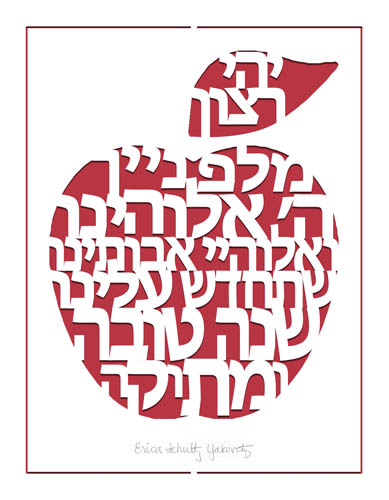
I did a custom Etsy order earlier this year for a text design in a faux-papercut style, which got me interested in doing one for myself. Papercutting is a traditional Jewish art form, and this piece incorporates a traditional Rosh Hashanah blessing: “May it be Your will, our God and the God of our ancestors, that You renew for us a good and sweet year.” These words are recited over the apples and honey that are so emblematic of Rosh Hashanah.

For my personal sending, I ordered 4.25″x5.5″ double-sided flat cards from OvernightPrints. But I’ve also posted a 5×7 version (customizable) on my Zazzle shop:
Rosh Hashanah Apple Papercut Card

Shanah tovah u’metukah! A good and sweet year to all my readers.

SaveSaveSaveSaveSaveSaveSaveSaveSaveSaveSaveSaveSaveSaveSaveSaveSaveSaveSaveSaveSaveSave

Free Printable Friday Night Prayerbook (Condensed Edition)

This past weekend was the Arisia science fiction convention, which is put on each January by several hundred of my closest friends in Boston, MA. I attended almost every Arisia from 1999 to 2014 (after which I moved back to the Midwest). In 2006, since all my geeky shul friends were attending the convention anyway, I started organizing a Friday night Kabbalat Shabbat service at the convention hotel. Those of us who were on the synagogue board borrowed a large (and heavy!) crate of assorted prayerbooks from Temple Beth Shalom of Cambridge every year to make the service happen.

This service, I am happy to say, is still going on, organized by Terri Ash (of Geek Calligraphy) and her family. But for 2017, Terri wanted a pamphlet-style siddur containing only the prayers for Friday night, that could be stored from year to year just for Arisia. But we weren’t aware of any existing siddur that fit our needs, so, what do we do? Build our own (based on the extensive resources available at the groundbreaking OpenSiddur.org website). She asked “Who wants to help make this happen?” and of course I said “Here I am!”  Continue reading

New art piece: If I Am Not For Myself, Who Will Be For Me? (2015 Edition)

I’m pleased to report that my Etsy shop, Schultz Yakovetz Judaica, is doing well. Not “quit my day job” well or anything, but I’ve literally sold more art in the last six months than I had in all the previous years—total—of selling via my website. (For that matter, it seems to have raised the profile of my own site, since a few of those recent sales came directly through my site rather than the Etsy shop. And even that was a statistically significant uptick.)

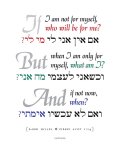
ifiam_originalMost recently, I happened to see a few orders in a row for one of my earliest pieces, a setting of Rabbi Hillel’s famous aphorism in Pirkei Avot:

If I am not for myself, who will be for me?
But when I am only for myself, what am I?
And if not now, when?
(Pirkei Avot 1:14)

Fun fact: I first created this piece in a handmade version as a gift for my dad back in 1994. The typeset version was designed some years afterward, but no later than 2001.

In other words, it’s gotten a little dated… especially as typographic decorative art has really come into fashion over the last few years (everywhere from Etsy to CB2 to Target) with a more contemporary aesthetic.

Looking at it with fresh eyes, I decided that it was really time for an update. So I created a new version.

This slideshow requires JavaScript.

While I was at it, I posted a downloadable version so that buyers can print their own copy (at any desired size) locally, rather than have me ship them an unframed print. One download includes PDFs of all three pieces.

Carpe diem!

How I make art, Part 1: Resources for Hebrew text

This week, I’ve been working on a new Judaica art piece, which I look forward to releasing next week! But before I get there, I wanted to talk about my process for making art out of text in Hebrew and English.

It starts where everything starts — with an idea. Some words catch my eye and fire my imagination. Most often, it’s either a Biblical text or a passage from the siddur, the Jewish prayerbook. (Frequently, it’s both, as Biblical quotations make up a significant portion of the wording of our formal prayers.) Occasionally, it’s a quote from the Talmud, about which more below.

But how do I get going from there? First, I go to the Internet!

… Why not start on my own bookshelf? I own numerous Bibles in both Hebrew and English (one of my favorite translations, incidentally, is Everett Fox‘s Five Books of Moses, a.k.a. the Schocken Bible). But here’s Confession #1: I’m not so strong on chapter and verse. So I start by doing a Google search for the English phrasing, in order to locate the verse I’m thinking of.

From there, I look up the Hebrew. Mechon Mamre maintains an excellent complete Hebrew-English online Bible, featuring the well-reputed standard English translation by the Jewish Publication Society (JPS). I will usually go here to copy and paste entire passages. Note, though, that they provide “pointed” text, with the nekudot: vowel marks and other punctuation that are positioned around the actual letters (or, in the words of psycholinguist Dorit Ravid, “diacritics ancillary to consonantal graphemes”).* This notation is essential for study purposes, but I generally go on to strip out the nikkud, because I prefer to use just the un-pointed letters in my artwork.

* However, the Ancillary Diacritics is totally my new band name.

My next stop is, perhaps surprisingly, a Christian Bible site, one called Blue Letter Bible. While I tend to steer clear of Christian-sponsored sites, this one offers a spectacular feature that I haven’t found elsewhere: a word-by-word breakdown of the original Hebrew, as well as the Greek from the Septuagint, for every single verse of the Old Testament.

[Blue Letter Bible tools screenshot]

The language tools at Blue Letter Bible. Careful observers will pick up a clue as to the forthcoming new art piece.

My own Hebrew skills are normally sufficient to match up the corresponding words from an English translation; in fact, this is an important element in my artwork, where I frequently color-code specific words or phrases to create explicit visual connections between the texts. But sometimes I feel like the English in front of me doesn’t quite capture the nuance I’m getting from the Hebrew. When I want to refine the translation I’m including in the piece, it can be amazingly helpful to see a range of English translations side-by-side, or to click through to the Strong’s Concordance entry to see how the same word has been interpreted in different contexts. Plus, they provide a box to toggle the “vowel points” (the aforementioned nekudot) on or off, so I can copy a whole verse with just the unpointed letters. Priceless.

Now, what if I am researching a Talmud quotation? Certain sections are easy to find in translation, like the tractate of Avot, better known as Pirkei Avot, or in English as “The Ethics of the Fathers”, which is reproduced in its entirety in most traditional prayerbooks. Often, however, I will see delightful quotes attributed solely to “The Talmud”… which may be technically accurate, but not very helpful! Google is my friend here again. Sometimes it turns out that quotes attributed to “The Talmud” (such as this one, identified here) actually come from Midrash Rabbah, which is a fantastic (and often fantastical) body of interpretive commentaries, but not part of the Talmud.

Once I can get a specific citation, I can look up the Hebrew in Mechon Mamre’s online Talmud Bavli (the “Babylonian” Talmud that is the version commonly studied). Some chapters are available in English at Halakhah.com, at Sacred Texts, and at the Jewish Virtual Library. If I’m looking for Midrash Rabbah, there’s a complete online Hebrew edition at Tsel Harim.

For Hebrew text from the prayerbook, I am more likely to turn to my actual bookshelf. However, there are several useful Web resources, such as the Online Siddur, the Open Siddur Project, and the Free Siddur Project.

There are many more great collections of links and scholarly resources at sites like the following:

One last technical note: I create my artwork in Adobe InDesign. Now, if I copy a line of Hebrew text from a web page, it is almost certainly in Unicode, which the browser knows to render right-to-left… but InDesign pastes in the character sequence from left to right. Because here’s Confession #2: I don’t actually use it to handle Hebrew properly. Now that I’ve upgraded to Creative Suite 6, its World-Ready Composer gives some built-in support for right-to-left sequencing at either the paragraph or character level… but the way it behaves still isn’t very intuitive for me, and I get frustrated after just a few minutes. It’s actually easier for me to cheat with an intermediate step: reversing the string in order to make it come out correctly. On a few old projects, I did this by hand (!), but these days I turn once again to the magic of the Internet, where there are handy web-based utilities for this purpose.

  • Reverse a String Online was my longtime quick-and-dirty favorite for single lines.
  • Text Mechanic’s “Reverse Text Generator” offers an additional option called “Flip Text”, which reverses each line (or technically paragraph), but keeps the lines themselves in the correct top-to-bottom sequence — just what I need for longer sections.

Once I’ve got all my text in place, in Hebrew and English, that’s my raw material. Only then can I start to play with it to create art. But that’s a totally separate process that I will try to address in another, less technical — and probably shorter! — post.

Shabbat shalom!

Because this is still a design blog: Who By Fire

I’ve occasionally tried my hand at creating holiday cards, but never anything particularly inspired, somehow.

Then during Rosh Hashanah services this year, I managed to remember that the Thing I Do is play around with text, especially Biblical or liturgical text… and there’s no shortage of great material in the High Holiday liturgy. Which excited me, even if it results in a bit of a departure from your basic apples-and-honey “good and sweet year” greeting card motif.

So here’s the first one:

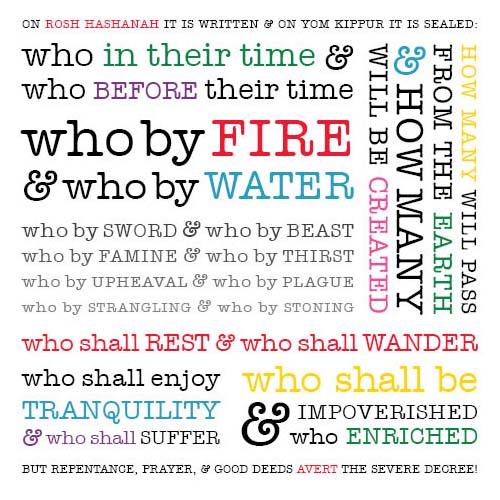
On Rosh Hashanah it is written, and on Yom Kippur it is sealed...

This famous liturgical passage is from the central U’netaneh Tokef section of the Rosh Hashanah Musaf prayer service. Click to enlarge.

I have a few more passages still in mind to work up. Next year I intend to actually get some of them printed up in time to use for the holiday… so I made sure to use up the last few mundane ones in my stash this year.

Edited to add (2015): Buy it on Zazzle!

Ketivah v’chatimah tovah: May you all be written and sealed for a good year.

Linkfest

I’ve been wanting for days and days to write some stuff about what’s happening on my interior landscape, but have been too busy churning out actual work (made some updates to my website, though, alongside working on the big book project). So, in lieu of content, you get some of the interesting things that have come up in the past several weeks.

Design & typography

Beautiful and colorful, both from This Is Colossal:
The Chromatic Typewriter: http://www.thisiscolossal.com/2011/12/the-chromatic-typewriter/?src=footer
A Massive Black Field of Cut Steel Plants Hides a Colorful Secret: http://www.thisiscolossal.com/2012/01/a-massive-field-of-cut-steel-plants-reveals-a-colorful-secret/

The Met has a new section on their (recently overhauled) website called “Connections”, a long series of thematic presentations with voiceovers by various Museum personnel and specialists. It’s really nice.
http://www.metmuseum.org/connections/

Of historical interest: a film about Linotype (click to read about/see the trailer if you don’t know what that is) that premiered in NYC this past weekend:

Linotype: The Film

“How to Build a Newsroom Time Machine”: Typesetting and layout the old-fashioned way, or, what “on the pasteboard” really means:

HOW TO BUILD A NEWSROOM TIME MACHINE

Writing

Gotham Writer’s Workshop offers FREE writing classes! (well, one-hour workshops, but it could be fun):
http://www.writingclasses.com/CommunityEvents/index.php

An old one from Neil Gaiman about how to get published and/or how to get an agent:
http://journal.neilgaiman.com/2005/01/everything-you-wanted-to-know-about.asp

Work

Fascinating:
Scaling back consumption in service of happiness:

See also: http://finance.yahoo.com/news/the-case-for-a-21-hour-work-week.html

Useful:
http://www.lifehack.org/articles/lifehack/the-100-best-lifehacks-of-2011-the-year-in-review.html
(srsly, read only the ones that you find interesting! Skip the rest!)

Relationships

Unbelievably beautiful:
http://www.huffingtonpost.com/arjuna-ardagh/goddess-worship_b_660896.html

Insightful:

30 Things to Stop Doing to Yourself


http://www.lifehack.org/articles/lifestyle/naming-elephants-10-ways-to-use-radical-honesty-to-improve-your-relationship.html

Not really so insightful, but several people pointed me at it:

Mmm!

Scotch tastings in NYC:
http://nycwhisky.com/events-old

Star Wars

I forget who pointed me at this, but I am totally loving it (and I’m on about page 52 of 600+ and counting — they just got up to Episode IV last month).
Darths & Droids is an “RPG screencap comic” that re-envisions Star Wars: Episode I (The Saga Begins) as a roleplaying campaign. Apparently inspired by DM of the Rings, but funnier in terms of making sense of the weaknesses of the source material.
http://www.darthsanddroids.net/episodes/0001.html

This reminds me that I also wanted to post this link when it first came to my attention several months ago:
Secret History of Star Wars: A Tribute to Marcia Lucas
http://secrethistoryofstarwars.com/marcialucas.html

Jewish

Jewish Sacred Theatre – Its Components and Its Means:
http://www.jewish-theatre.com/visitor/article_display.aspx?articleID=525

A handy nuts-and-bolts link on kashering your kitchen:
http://njop.org/resources/kosher/how-to-keep-kosher/

Type/language/publishing geeking links

In honor of my first day of full-time self-employment (as it were), I present a barrage of links that will interest a certain like-minded subset of readers.

Fonts.com’s For Your Typographic Information:
http://www.fonts.com/AboutFonts/Articles/fyti/index.htm

Type Trading Cards (gotta catch ’em all!):
http://www.fonts.com/AboutFonts/Articles/TypeTradingCards/

Helvetica (a film about typography, screening, incidentally, at MassArt at 7pm on April 11, sayeth ):
http://helveticafilm.com/

Type 1 fonts for TeX use:
CTAN directory: http://www.ctan.org/tex-archive/fonts/amsfonts/ps-type1/
AMS: http://www.ams.org/tex/type1-fonts.html

Fontifier: Your own handwriting as a TrueType font for just $9 (yes, I got one and so did ):
http://www.fontifier.com/index.html

Lorem Ipsum (all true typesetting geeks know that this refers to randomized pseudo-Latin filler text) randomizing generator:
http://www.lipsum.com/

Free online graph paper PDFs:
http://www.incompetech.com/beta/plainGraphPaper/

Glossary of bookbinding terms:
http://www.uflib.ufl.edu/preserve/binding/glossary.htm

Non-typographical, but useful: Converting a photo to a “painting” in Photoshop:
http://www.myjanee.com/tuts/painted/painted.htm

Non-publishing-related, but language-geekful: the Speech Accent Archive
http://accent.gmu.edu/index.php

Bookbuilders of Boston’s list of production-related publishing jobs in the greater Boston area:
http://www.bbboston.org/pageJobs.cfm

… And now, to send out a shul e-mail and hit the showers. :-D