SCOTUS Angels update: Nonviolent (gun-free) edition

At last writing, I had recently released the original SCOTUS Angels design and promised (after many inquiries) to create a nonviolent, gun-free version.

Things that have happened since then:

  • On March 8, Amy Hagstrom Miller, founder/president of Whole Woman’s Health and lead plaintiff on Whole Woman’s Health v. Hellerstedt, contacted me on Facebook to ask if I would consider directing the proceeds toward the Center for Reproductive Rights (the nonprofit law firm representing WWH to the Supreme Court), rather than my go-to of Planned Parenthood. I was happy to agree to this idea. Ten percent of the royalties from this design (both versions) will now benefit the Center for Reproductive Rights.
  • Also on March 8, Zazzle pulled down every product using the first design, on the grounds of copyright (really trademark) infringement. Alas!
  • On March 12, I released the gun-free version. In this edition, justice is being served with the tools of law (symbolized by gavels, scales, and books) rather than with weapons. I posted both designs on an art site called Society6, about which I had heard good things. However, their product selection is more limited than Zazzle’s (no bumper stickers! no plus sizes!), so I also went back and posted the new design on Zazzle. So far, it’s remained up with no copyright issues.
  • Tangentially, but not for nothing: On March 16, President Obama nominated Merrick Garland to fill the SCOTUS vacancy. (Side note: if approved, his appointment would increase the count of Jews on the Court to 4 out of 9, joining Justices Ginsburg, Breyer, and Kagan.) Dear Senate Judiciary Committee: Approve or reject him as you see fit, but please, #DoYourJob and hold the hearings.

Anyway. Shop the collections:


Purim is coming! Have some music!

Mishenichnas Adar, marbin b’simcha.
“When the month of Adar enters, we increase in joy.”
— Gemara (Taanit 29b)

Quick primer: Today is the first day of the Hebrew month of Adar. In fact, it’s the first day of the second month of Adar, since this year is a leap year — which, in the Jewish lunar calendar, means not just adding an extra day but a whole extra month (known in those years as Adar I).

The point is, it’s less than two weeks until the festival of Purim, when we celebrate the Persian Jews’ deliverance from persecution in the fourth century BCE, as detailed in the Book of Esther.

So I wanted to share some little-known Purim music collections… the perfect soundtrack for your hamantashen baking.

First, The Ramaz School in NYC (where I was the webmaster from 2011-2014) produced an album of Purim songs in 2012, featuring both students and faculty. The whole collection can be played or downloaded for free at web.ramaz.org/purim/index.html. Brush up on standards like Mishenichnas Adar and Shoshanat Yaakov, and enjoy some new and original compositions. Yasher koach to Ramaz for being leaders in Jewish education and music education, as well as service to the greater community.

ramaz-purim_photo-bar_1000px

Second, I would be remiss not to point out the two Purim-themed operas by David Bass, The Coronation of Esther (2001) and its sequel Springtime for Haman (2004). The North Cambridge [MA] Family Opera Company hosts recordings of both operas:

Chodesh tov and shabbat shalom!

New project: SCOTUS Angels

Hi. This is Erica. Apparently I won the Internet this weekend, with a little Photoshop riff on a classic tableau.

“Once upon a time there were three brilliant women who went to the Supreme Court. Two Jewish, the other Latina. And now they work for me. My name is Social Justice.”

Posted by Erica Schultz Yakovetz on Saturday, March 5, 2016

Inspired by Dahlia Lithwick’s March 2 Slate article on Whole Woman’s Health v. Hellerstedt, my friend Laurie asked for a T-shirt of Justices Ginsburg, Kagan and Sotomayor in a Charlie’s Angels pose. Saturday night, I released this:

This slideshow requires JavaScript.

That’s the Notorious RBG in the center, with Elena Kagan at left and Sonia Sotomayor at right. The white jabots are based on the real versions sported by each of these amazing women.

Now you, too, can have that T-shirt, thanks to Zazzle. There are different variations for different background colors, so the product line is getting a little complex. I’m curating the full set at this link: SCOTUS Angels Collection.

I’m pledging 10% of my royalties to Planned Parenthood. UPDATE, 3/8/16: Amy Hagstrom Miller, the lead plaintiff in Whole Women’s Health v. Hellerstedt, reached out to me today to ask if the proceeds could instead support the Center for Reproductive Rights (the nonprofit law firm representing WWH for this case). So, while the first $50 based on sales to date will still go to Planned Parenthood (my go-to, along with Medical Students for Choice and the ACLU, for my regular charitable support), I am happy to direct 10% of the future proceeds to the Center. Thank you, Amy, for your activism! And Happy International Women’s Day!

And after many requests, YES, I will be creating a nonviolent (gun-free) version in the near future. Gavels, law book, scales of justice. Something. Watch this space.

Chanukah song sheet (free downloadable)

Chanukah_FBbanner
In honor of Chanukah starting tonight, I wanted to share the link to my free downloadable Chanukah song sheet (available on the “Ritual Materials” page of my Judaica site).

Everyone loves to sing at Chanukah parties (don’t they??), but no one can remember the words to anything more than one verse of Ma’oz Tzur. Now you can! This version, produced in 2011, includes all the Chanukah candle-lighting blessings (with transliterated Hebrew) PLUS the lyrics to 12 favorite Chanukah tunes, all on one easily-photocopied 8.5×11″ sheet (double-sided).

… Oh, and lest I forget, there’s also my ever-expanding Chanukah YouTube playlist.

Chag sameach, all. Now excuse me while I go start peeling potatoes!

New art piece: If I Am Not For Myself, Who Will Be For Me? (2015 Edition)

I’m pleased to report that my Etsy shop, Schultz Yakovetz Judaica, is doing well. Not “quit my day job” well or anything, but I’ve literally sold more art in the last six months than I had in all the previous years—total—of selling via my website. (For that matter, it seems to have raised the profile of my own site, since a few of those recent sales came directly through my site rather than the Etsy shop. And even that was a statistically significant uptick.)

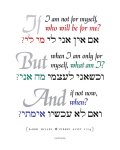
ifiam_originalMost recently, I happened to see a few orders in a row for one of my earliest pieces, a setting of Rabbi Hillel’s famous aphorism in Pirkei Avot:

If I am not for myself, who will be for me?
But when I am only for myself, what am I?
And if not now, when?
(Pirkei Avot 1:14)

Fun fact: I first created this piece in a handmade version as a gift for my dad back in 1994. The typeset version was designed some years afterward, but no later than 2001.

In other words, it’s gotten a little dated… especially as typographic decorative art has really come into fashion over the last few years (everywhere from Etsy to CB2 to Target) with a more contemporary aesthetic.

Looking at it with fresh eyes, I decided that it was really time for an update. So I created a new version.

This slideshow requires JavaScript.

While I was at it, I posted a downloadable version so that buyers can print their own copy (at any desired size) locally, rather than have me ship them an unframed print. One download includes PDFs of all three pieces.

Carpe diem!

New for 2015: I’m in a book!

Last month, I received an email inquiry from a photographer named Susan Ressler, formerly of Indiana (she is Professor Emerita of Visual and Performing Arts at Purdue University) and now of New Mexico. elements

Susan was preparing to self-publish a book of her fine art photography from a recent trip to Israel, organized (as it happened) into sections based on the elements: Air, Fire, Water, and Earth. She had come across my 2007 piece Elements: The Holy Cities and wanted to include it in the introduction to her book, as a way of setting the stage!

Her completed book, Understanding Israel (subtitle: “Jaffa is More than Oranges”), is now live on a print-on-demand site called Blurb. It’s available in two trim sizes: 8×10 ($45.99) or the more luxurious 11×13 ($99.95), both in a dramatic landscape format. If you click on the title above, you can browse through the entire book. For the curious, my contribution is on page 10 :-) but the rest is well worth a look.

Below is the official Blurb “badge” for the book:

Understanding Israel (8x10
Understanding …
Jaffa is More than…
By Susan Rebecca Ressler
Photo book

 
(And also, since apparently this is my first post in the new year: Happy 2015!)

Designs for the Blue Hill Troupe’s 2014 Ruddigore

As many of you know, for the last two years I have been a Backstage member of the Blue Hill Troupe, Ltd., the only musical theater group in New York City to donate its net proceeds to charity.

Last year, I was privileged to serve as the Troupe’s Marketing Graphics coordinator, as well as the lead Program Designer. Since I’m still catching the blog up on all my projects from Spring 2014, here’s a look at the materials I produced for their April 2014 show, Gilbert & Sullivan’s Ruddigore.

[portraits]

The original Act II sketch.

Historically, the Troupe has often based show graphics on the concept sketches of the set design. For this Ruddigore, I was totally enamored of the richly toned watercolor artwork that the set designer (noted NYC architect Byron Bell) produced for the iconic Act II “ancestor portraits” set, so I was keen to figure out a way to work with that.

As a background for text, however, this selection presented some challenges: it’s not only very busy, it’s also highly discontinuous, the dark background being heavily cut by the white grid of the portrait frames. My techniques for adapting to this background included:

  • deepening the color values as much as I could without losing contrast or detail;
  • using white (or “reversed out”) text against the primarily dark background;
  • setting most of the text in the very simple and legible Myriad Pro (except for the ornate title, set in Blackadder) to help counteract the heavy texture of the background;
  • adding a subtle gray outline stroke to the letterforms to create a boundary against the lighter areas of the art;
  • strategically adjusting the composition (via cropping, sizing, and positioning) to create as much neutral space for the text as possible while preserving concrete elements of the stage set (table, candelabra, freestanding portrait) as a visible frame.

The first piece we produced was a 4×9″ postcard. Over the course of the year, I adapted this layout into several more single-sided pieces such as display ads, our Facebook cover page, other web graphics, and an 11×17″ window poster for our Brooklyn workspace. Later, there was a quad-fold 8.5×14″ brochure that included a ticket order form.

This slideshow requires JavaScript.

Finally, I also got to serve as lead designer on the program booklet, which is a glossy 136-page perfect-bound extravaganza with a full-color cover. For the cover here, we turned to another of Byron’s sketches: the wrought-iron gates of the tiny Cornish fishing village of Rederring. (This elaborate set piece was incorporated into the overture, then dramatically flown out at the top of Act I.)

The program cover.

The program cover.

Since this was a simple line-art sketch, I placed it on a parchment background, then used a striking red shade to highlight the “ruddy gore” of the title text. This treatment produced a thoroughly different look that still worked thematically for our melodramatic period piece. For consistency, I kept the same title logotype as on the promotional materials, but I wanted the rest of the program to evoke the old-fashioned typography of a vintage newspaper, so I used Bodoni for both body and display text throughout.

Note that, having moved away from NYC to Indiana immediately after the show closed in April, I’ll be an Associate member of the Troupe for the coming year… though I’m still on call for the occasional design project! Their 2014-15 season includes Lucky Stiff this November (for which rehearsals are now in progress) and Gilbert & Sullivan’s Patience next April. Break legs, all!

New website project launch: Growing Minds

A good friend and colleague in the Boston area, Dr. Anya Dashevsky, is launching a private psychology practice, and I had the privilege of assisting her with her marketing materials.

She had already decided on a name for her new practice: Growing Minds. She made sure that the domain name growingmindspsych.com was currently available, so we moved forward with that. She specializes in assessment of children (starting as young as 18 months) through adolescents, so she had come up with a name that conveys both the objective (minds that are growing) and the process of assisting those minds to grow and develop.

My first task was to come up with a logo. I wanted to capture that same duality, so I used two contrasting typefaces:

  • a script face known as Banshee with a dynamic, organic feel, and
  • Book Antiqua (Microsoft’s knockoff of Palatino), which will also be suitable for general text use in her website and business materials.

For her branding colors, I chose green to represent optimal growth, and blue to connote a calming, supportive, and trustworthy presence for the presumably-anxious parents seeking her services. (Note that blue is a common choice among medical practices as well as financial institutions.) I provided a wide range of alternative concepts, but this jewel-toned scheme was the one my client was drawn to, so I knew we were on to something!

[Growing Minds]

The two-sided business card featuring the final logotype.

Next, we worked together to create a website for her practice that would provide substantive information as well as basic logistical details to inquiring new clients. We settled on a clean white background and a simple page template that would perform just as well for iPad visitors as for desktop browsers. All the text is in Book Antiqua to match her brand identity.

[GrowingMindsPsych.com]

The finished website frontpage. Look at that smile! Click to browse the full site.

This site build uses pure CSS, no JavaScript, to achieve both the dropdown main menu tabs and the click-to-expand bullet points on the front page. The menu code was adapted from this simple but effective version on CSSMenuMaker.com. The bullet point code was substantially adapted from this vertical accordion on sitepoint.net — they made use of CSS3’s built-in :target selector, and I had to change around the code to make it function under CSS2, but the basic structure remained the same.

The site is hosted on 1and1.com (Mr. Y’s recommended vendor for basic, economical web hosting). I had my client set up her own customer account, then went in myself to set up the domain name (growingmindspsych.com), post a placeholder page, and eventually transfer the files for the full site once the design and content were complete.

My client’s new practice officially opened this week in her Lexington, MA, office. Congratulations and best wishes for much success! (We’re still working on the coordinating brochure. I’ll post that as a follow-up when it’s completed.)

New art piece: To Everything There Is A Season

Today is Rosh Chodesh Elul (which means only one month to Rosh Hashanah). In honor of the new Hebrew month, I’m debuting a new art piece!

As a young teenager, I was deeply into the music of the 1960s, and I still remember getting goosebumps the first time I heard the Byrds’ 1965 hit recording of Pete Seeger’s “Turn! Turn! Turn! (To Everything There Is a Season)”.

I knew it was taken from a passage in the Book of Ecclesiastes, though I didn’t know much more about it than that. Much later, I experienced Ecclesiastes as the Hebrew scroll of Kohelet, which is traditionally ascribed (like the book of Proverbs, or Mishlei ) to King Solomon, and in many Jewish communities is read aloud in its entirety at Shabbat synagogue services during the fall holiday of Sukkot.

A couple of years ago, at a friend’s house, I saw a framed calligraphy piece based on this same passage, Ecclesiastes 3:1-8. That inspired me to want to do a version of my own.

The primary motif I had in mind was to set the English phrases as a sine wave or a helix, winding around the structure of the Hebrew. The above-and-below undulation would convey the duality in each of the pairings. Each Hebrew phrase is color-matched with its English equivalent to create a visual connection between the two levels. I chose to invert the Hebrew in these layers so that the text flow of both languages could run in the same clockwise direction — another way to echo the “wheel of time” feeling of the passage.

Ultimately, I arranged the text in a mandala of four nesting circles. The outermost circle is formed from the opening verse, which provides the conceptual frame for the whole passage. The second layer contains eight pairings, the third layer five pairings, and the last pairing forms the final circle with “peace” at its center… driving the whole composition, like Pete Seeger’s adaptation, toward an optimistic goal at its core.

One note on the translation: The well-known King James Version translates the second half of verse 1 as “and a time to every purpose under the heaven”. The Hebrew word used there, however, is cheifetz, which in other contexts is always rendered as “please” or “enjoy”. (Compare to Psalm 115:3, V’elokeinu ba-shamayim; kol asher chafetz asah. “Our God is in the heavens; He does whatever He pleases.”) Thus, some English translations give it as “to every delight” or “pleasure under the heavens”. Many other translations simply say “event”, “matter” or “activity”. I wanted to find a word that conveyed the semantic direction of “pleasing” without categorizing killing and destroying as “delights”, and settled on “to every impulse under the heavens.” I also tried to preserve the distinctions in the Hebrew between “a time to [verb]” and “a time of [noun]”.

This slideshow requires JavaScript.

I created Version I using the classical Roman-style font Trajan for all of the English text, for a smooth and formal look. However, then I wanted to try to bring out the (literal) texture of the passage with a little more contrast, so I experimented with applying a calligraphic italic hand (a font called Aquiline) to accent the changing keywords in each English phrase. This resulted in Version II.

Both pieces are now available in my Etsy shop, along with a hi-res PDF download that includes both versions in case you prefer to print your own.

Which version do you think works best? Let me know in comments.

Chodesh tov!