New art piece: To Everything There Is A Season

Today is Rosh Chodesh Elul (which means only one month to Rosh Hashanah). In honor of the new Hebrew month, I’m debuting a new art piece!

As a young teenager, I was deeply into the music of the 1960s, and I still remember getting goosebumps the first time I heard the Byrds’ 1965 hit recording of Pete Seeger’s “Turn! Turn! Turn! (To Everything There Is a Season)”.

I knew it was taken from a passage in the Book of Ecclesiastes, though I didn’t know much more about it than that. Much later, I experienced Ecclesiastes as the Hebrew scroll of Kohelet, which is traditionally ascribed (like the book of Proverbs, or Mishlei ) to King Solomon, and in many Jewish communities is read aloud in its entirety at Shabbat synagogue services during the fall holiday of Sukkot.

A couple of years ago, at a friend’s house, I saw a framed calligraphy piece based on this same passage, Ecclesiastes 3:1-8. That inspired me to want to do a version of my own.

The primary motif I had in mind was to set the English phrases as a sine wave or a helix, winding around the structure of the Hebrew. The above-and-below undulation would convey the duality in each of the pairings. Each Hebrew phrase is color-matched with its English equivalent to create a visual connection between the two levels. I chose to invert the Hebrew in these layers so that the text flow of both languages could run in the same clockwise direction — another way to echo the “wheel of time” feeling of the passage.

Ultimately, I arranged the text in a mandala of four nesting circles. The outermost circle is formed from the opening verse, which provides the conceptual frame for the whole passage. The second layer contains eight pairings, the third layer five pairings, and the last pairing forms the final circle with “peace” at its center… driving the whole composition, like Pete Seeger’s adaptation, toward an optimistic goal at its core.

One note on the translation: The well-known King James Version translates the second half of verse 1 as “and a time to every purpose under the heaven”. The Hebrew word used there, however, is cheifetz, which in other contexts is always rendered as “please” or “enjoy”. (Compare to Psalm 115:3, V’elokeinu ba-shamayim; kol asher chafetz asah. “Our God is in the heavens; He does whatever He pleases.”) Thus, some English translations give it as “to every delight” or “pleasure under the heavens”. Many other translations simply say “event”, “matter” or “activity”. I wanted to find a word that conveyed the semantic direction of “pleasing” without categorizing killing and destroying as “delights”, and settled on “to every impulse under the heavens.” I also tried to preserve the distinctions in the Hebrew between “a time to [verb]” and “a time of [noun]”.

This slideshow requires JavaScript.

I created Version I using the classical Roman-style font Trajan for all of the English text, for a smooth and formal look. However, then I wanted to try to bring out the (literal) texture of the passage with a little more contrast, so I experimented with applying a calligraphic italic hand (a font called Aquiline) to accent the changing keywords in each English phrase. This resulted in Version II.

Both pieces are now available in my Etsy shop, along with a hi-res PDF download that includes both versions in case you prefer to print your own.

Which version do you think works best? Let me know in comments.

Chodesh tov!

How I make art, Part 1: Resources for Hebrew text

This week, I’ve been working on a new Judaica art piece, which I look forward to releasing next week! But before I get there, I wanted to talk about my process for making art out of text in Hebrew and English.

It starts where everything starts — with an idea. Some words catch my eye and fire my imagination. Most often, it’s either a Biblical text or a passage from the siddur, the Jewish prayerbook. (Frequently, it’s both, as Biblical quotations make up a significant portion of the wording of our formal prayers.) Occasionally, it’s a quote from the Talmud, about which more below.

But how do I get going from there? First, I go to the Internet!

… Why not start on my own bookshelf? I own numerous Bibles in both Hebrew and English (one of my favorite translations, incidentally, is Everett Fox‘s Five Books of Moses, a.k.a. the Schocken Bible). But here’s Confession #1: I’m not so strong on chapter and verse. So I start by doing a Google search for the English phrasing, in order to locate the verse I’m thinking of.

From there, I look up the Hebrew. Mechon Mamre maintains an excellent complete Hebrew-English online Bible, featuring the well-reputed standard English translation by the Jewish Publication Society (JPS). I will usually go here to copy and paste entire passages. Note, though, that they provide “pointed” text, with the nekudot: vowel marks and other punctuation that are positioned around the actual letters (or, in the words of psycholinguist Dorit Ravid, “diacritics ancillary to consonantal graphemes”).* This notation is essential for study purposes, but I generally go on to strip out the nikkud, because I prefer to use just the un-pointed letters in my artwork.

* However, the Ancillary Diacritics is totally my new band name.

My next stop is, perhaps surprisingly, a Christian Bible site, one called Blue Letter Bible. While I tend to steer clear of Christian-sponsored sites, this one offers a spectacular feature that I haven’t found elsewhere: a word-by-word breakdown of the original Hebrew, as well as the Greek from the Septuagint, for every single verse of the Old Testament.

[Blue Letter Bible tools screenshot]

The language tools at Blue Letter Bible. Careful observers will pick up a clue as to the forthcoming new art piece.

My own Hebrew skills are normally sufficient to match up the corresponding words from an English translation; in fact, this is an important element in my artwork, where I frequently color-code specific words or phrases to create explicit visual connections between the texts. But sometimes I feel like the English in front of me doesn’t quite capture the nuance I’m getting from the Hebrew. When I want to refine the translation I’m including in the piece, it can be amazingly helpful to see a range of English translations side-by-side, or to click through to the Strong’s Concordance entry to see how the same word has been interpreted in different contexts. Plus, they provide a box to toggle the “vowel points” (the aforementioned nekudot) on or off, so I can copy a whole verse with just the unpointed letters. Priceless.

Now, what if I am researching a Talmud quotation? Certain sections are easy to find in translation, like the tractate of Avot, better known as Pirkei Avot, or in English as “The Ethics of the Fathers”, which is reproduced in its entirety in most traditional prayerbooks. Often, however, I will see delightful quotes attributed solely to “The Talmud”… which may be technically accurate, but not very helpful! Google is my friend here again. Sometimes it turns out that quotes attributed to “The Talmud” (such as this one, identified here) actually come from Midrash Rabbah, which is a fantastic (and often fantastical) body of interpretive commentaries, but not part of the Talmud.

Once I can get a specific citation, I can look up the Hebrew in Mechon Mamre’s online Talmud Bavli (the “Babylonian” Talmud that is the version commonly studied). Some chapters are available in English at Halakhah.com, at Sacred Texts, and at the Jewish Virtual Library. If I’m looking for Midrash Rabbah, there’s a complete online Hebrew edition at Tsel Harim.

For Hebrew text from the prayerbook, I am more likely to turn to my actual bookshelf. However, there are several useful Web resources, such as the Online Siddur, the Open Siddur Project, and the Free Siddur Project.

There are many more great collections of links and scholarly resources at sites like the following:

One last technical note: I create my artwork in Adobe InDesign. Now, if I copy a line of Hebrew text from a web page, it is almost certainly in Unicode, which the browser knows to render right-to-left… but InDesign pastes in the character sequence from left to right. Because here’s Confession #2: I don’t actually use it to handle Hebrew properly. Now that I’ve upgraded to Creative Suite 6, its World-Ready Composer gives some built-in support for right-to-left sequencing at either the paragraph or character level… but the way it behaves still isn’t very intuitive for me, and I get frustrated after just a few minutes. It’s actually easier for me to cheat with an intermediate step: reversing the string in order to make it come out correctly. On a few old projects, I did this by hand (!), but these days I turn once again to the magic of the Internet, where there are handy web-based utilities for this purpose.

  • Reverse a String Online was my longtime quick-and-dirty favorite for single lines.
  • Text Mechanic’s “Reverse Text Generator” offers an additional option called “Flip Text”, which reverses each line (or technically paragraph), but keeps the lines themselves in the correct top-to-bottom sequence — just what I need for longer sections.

Once I’ve got all my text in place, in Hebrew and English, that’s my raw material. Only then can I start to play with it to create art. But that’s a totally separate process that I will try to address in another, less technical — and probably shorter! — post.

Shabbat shalom!

Poppin: Gorgeous office supplies for color nerds

I first saw it in a Facebook ad. I try to avoid EVER clicking Facebook’s sidebar ads, but the picture in this one was so appealing, I couldn’t resist: a spotless white office desk tricked out with a whole suite of beautiful, brightly colored, matching office supplies.

This was my introduction to Poppin, whose mission statement begins, “Poppin believes you should be able to surround yourself with objects of beauty everywhere you go and in everything that you do.” Founded in 2009 by NYC entrepreneurs with a background in fashion (explains the killer aesthetics, right?), the company was publicly launched in September 2012, but it’s only more recently that their impressive PR is really gaining traction.

The sheer glossy perfection of it was what got me. I was in awe. Not just visually, but technically: How do you even achieve that kind of color matching across a dozen different materials and manufacturers? (It turns out that this was, indeed, a nontrivial issue for them.) I emailed the Shop By Color link straightaway to my BFF (an avowed devotee of all things purple). I followed Poppin on Pinterest. And then on Twitter. I was hooked.

But it wasn’t enough for me to lovingly browse the color selections. I had to know: What were the specs for the 16 colors?? With a few minutes of poking around their website style sheets, I managed to uncover the official hex/RGB codes. But even more specifically, I wanted to know if they had officially designated corresponding swatches in the industry-standard Pantone Matching System, or PMS. Read more about Pantone here.

I couldn’t find any mention of Pantone in their FAQ, but luckily, Poppin also encourages you to email questions to their “Work Stylist” team. So I did. Not 45 minutes later, team member Shannon sent me a perky response email with an attached PDF document — an array of the 16 swatches with their PMS numbers. My respect for the company ratcheted up several more notches.

I asked her if I could share the breakdown, and she said “feel free to spread the info!”, so here it is:

Name Hex RGB Pantone
White  #ffffff  R: 255 G: 255 B: 255 n/a*
Yellow  #ffd200  R: 255 G: 210 B: 0 PMS 116C
Orange  #f47b20  R: 244 G: 123 B: 32 PMS 166C
Coral  #ff6666  R: 255 G: 102 B: 102 PMS 178C
Red  #d31245  R: 211 G: 18 B: 69 PMS 200C
Pink  #eb4498  R: 235 G: 68 B: 152 PMS 219C
Lime Green  #c1d82f  R: 193 G: 216 B: 47 PMS 382C
Mint  #abd2aa  R: 171 G: 210 B: 170 PMS 2254C
Aqua  #68c8c6  R: 104 G: 200 B: 198 PMS 325C
Pool Blue  #00a5d9  R: 0 G: 165 B: 217 PMS 639C
Navy  #00457c  R: 0 G: 69 B: 124 PMS 295C
Purple  #52247f  R: 82 G: 36 B: 127 PMS 2617C
Light Gray  #c5c6c8  R: 197 G: 198 B: 200 PMS 421C
Silver  n/a**   PMS 877C
Gold  n/a**   PMS 871C
Black  #000000  R: 0 G: 0 B: 0 PMS Black 6C

*Pantone does actually offer a selection of white shades, but Poppin didn’t spec one. :-)
** These metallics are represented on their website with background GIFs instead of solid CSS color blocks.

For now, the CMYK equivalents (for use in four-color process printing, including your home or office laser printer) are left as an exercise to the reader. (Pro tip: InDesign will give you a reasonable conversion right in your Swatches library if you create a swatch of your target PMS color, then convert to CMYK. This will give you a slightly better match than converting from an RGB swatch, since those can be tricky to render with the same vibrancy in CMYK.)

Guess what else? If your branding colors happen to be in the above set, you’ll be thrilled to know that you can also order your choice of custom imprinted products. (Some stellar product placement on that page, BTW. Internet cachet cuts both ways!)

So which are my personal favorite shades of the collection? If you’ve seen my design homepage, it’s no surprise that I’m torn between Lime Green (canonically the most “Erica” of colors) and Pool Blue.

I look forward to seeing what else they add to the menu as the company grows.

Space ketubahs!

Today is Tu B’Av (the 15th day of the Hebrew month of Av, a date sometimes known as the “Jewish Valentine’s Day”)… and our 6-month wedding anniversary is coming up in just a couple days. So in honor of those two romantic observances, let me share with you one of my favorite wedding-related design projects.

In planning a Jewish (or, in our case, Jewish-style interfaith) wedding, one of the fun things to work on is the ketubah, or marriage contract. This traditional document is signed — usually by two witnesses, the couple, and the officiant — on the wedding day, often in a separate ritual before the actual ceremony, though our rabbi had us incorporate the signing right into the ceremony.

Now, anyone who knows Mr. Y at all knows that he is a huge Star Wars geek (you should see the collection in our upstairs hallway). But what is only slightly less well known is that he is also a longtime real-life astronomy buff, who worked for many years in the local community planetarium (WHICH WE TOTALLY HAVE, FYI, and which he has yet to take me to visit, but I digress).

So when I started thinking about what would make the most awesome motif for our ketubah, the answer was SPACE.

When I emailed a first set of drafts to Mr. Y, I couldn’t resist including this version, which I made on a lark (click to enlarge):

DEATH-STAR-KETUBAH

While this had precisely the desired effect (“That’s FANTASTIC! … I totally cracked up when I saw the Star Wars version. Freaking great! You are awesome.”), we concurred that it probably wasn’t seriously the best way to go, no matter how perfectly it would complement the set of movie posters in our living room.

But I’d also created a draft that we would eventually refine into this:

SPACE-KETUBAH

After editing together the final art assembly, I spent some time looking for just the right Biblical text to draw in the cosmic theme, and ended up with Psalm 19: “The heavens tell the glory of God… In them He has set a tent for the sun, which emerges like a bridegroom from his chuppah, like a hero rejoicing to run his course” (19:1, 4-5). How’s that for relevance? This passage is used as a decorative border all around the piece, mostly as white text, with corresponding key words accented in yellow in both the English and the Hebrew.

Note that since Mr. Y is not Jewish, this text is not the traditional ketubah text, but basically a completely unrelated text in English and modern Hebrew, one that I had received previously for a custom ketubah project. We liked the wording a lot, but just as importantly, I also trusted the Hebrew translation to be not only accurate, but idiomatically correct (this is often not the case with Hebrew translations of custom texts; I could do a whole post of horror stories on that topic).

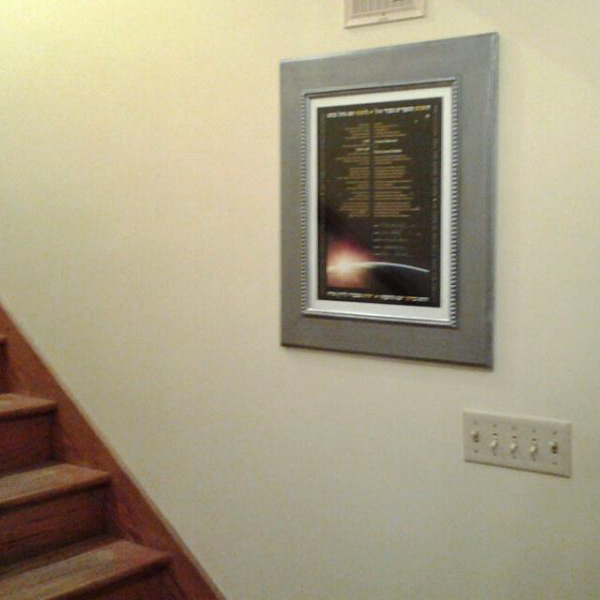
And, since everyone asks, the final version was signed in silver Sharpie. (Just one more of their million uses. :-) It’s now happily framed in our front hallway:

SPACE-KETUBAH-framed

30 Days, 30 Posts: NaBloPoMo is here!

In November of last year, I actually decided I would try National Novel Writing Month, a.k.a. NaNoWriMo. I didn’t actually get very far; I did make some headway on framing out a storyline I had been kicking around for literally years, but then the month caught up with me, and I didn’t get much past 10.000 words (the definitional goal is 50,000 words before December 1).

However, some inspired folks have decided that if turning out writing is the goal, 30 blog posts in 30 days is also a worthwhile benchmark, and thus NaBloPoMo was born. This, I think, may be more achievable for me. Let’s see how it goes! (I’ll be counting both WordPress and LiveJournal posts for this purpose.)

Michelle Weber's avatarWordPress.com News

There’s a lot of buzz each November around NaNoWriMo — you may notice some of your favorite blogs dedicating themselves to churning out 50,000 words this month.

If 50,000 words seem like 49,000 too many or you’re more interested in blogging than writing a book, NaBloPoMo — National Blog Posting Month — might be your speed: a challenge to post once every day for the entire month of November. No theme, no word count, no rules; just you, your blog, and 30 new posts.

NaBloWhatNow?

NaBloPoMo started in 2006 in response to NaNoWriMo; not every blogger has the time or inclination to write a book, but the idea of a challenge that forces participants to stretch themselves, grow as bloggers, and be part of a supportive community is undeniably appealing. As founder Eden Kennedy, the power blogger behind fussy.org, put it:

If there’s one thing creative people…

View original post 782 more words

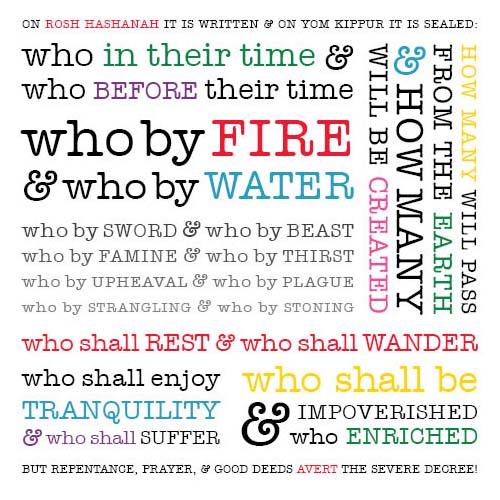
Because this is still a design blog: Who By Fire

I’ve occasionally tried my hand at creating holiday cards, but never anything particularly inspired, somehow.

Then during Rosh Hashanah services this year, I managed to remember that the Thing I Do is play around with text, especially Biblical or liturgical text… and there’s no shortage of great material in the High Holiday liturgy. Which excited me, even if it results in a bit of a departure from your basic apples-and-honey “good and sweet year” greeting card motif.

So here’s the first one:

On Rosh Hashanah it is written, and on Yom Kippur it is sealed...

This famous liturgical passage is from the central U’netaneh Tokef section of the Rosh Hashanah Musaf prayer service. Click to enlarge.

I have a few more passages still in mind to work up. Next year I intend to actually get some of them printed up in time to use for the holiday… so I made sure to use up the last few mundane ones in my stash this year.

Edited to add (2015): Buy it on Zazzle!

Ketivah v’chatimah tovah: May you all be written and sealed for a good year.

Big performance news: The Bliss Jockeys

Yesterday, I signed on as a backup vocalist with NYC rock band The Bliss Jockeys, fronted by the remarkable and charismatic Phil Robinson and backed by a gospel-choir-style ensemble of 7 female singers. “Part rock, part gospel & part jam band, The Bliss Jockeys feature a large, over-the-top sound and deliver an energizing and delirious experience every time!” Their debut album, The Birth of Bliss, is close to complete and will be forthcoming in 2013 from Roomful of Sky Records.

How it came about: Last weekend was my 20th (shhh) college reunion at Brandeis University. Phil, along with two of his ’98 classmates (having their 15th), were assigned totally at random as my suitemates in the reunion housing on campus. All of them turned out to be completely awesome and the best thing about my weekend. On Saturday night, after the class dinner, we all sat up until about 2am drinking bourbon and singing a cappella harmonies to the Indigo Girls and Cat Stevens and Simon & Garfunkel, and finally Phil turned to me and said “Hey! You are awesome and should join my band! I need a female vocalist! We rehearse on Monday nights!”

… Now it happened that, within just the past few weeks, I had started having the thought, “Hey, I would really like to look for an a cappella/vocal group to join again. I bet I could find one of those somewhere in NYC that would take me.” (As longtime acquaintances know, in Boston I was a member of Jewish a cappella group Honorable Menschen from 2003 to 2011, and only quit when I moved to NYC. So it was a huge part of my life for 8 years.)

Also, Monday is one of the few nights in the week I had totally free.

While this obviously isn’t a cappella, the opportunity is close enough that it is going on my archival list of “things that have fallen into my lap precisely when I needed and asked the Universe for them”.

Sunday night I returned to NYC; Monday night I sat in on a rehearsal, and I was thoroughly delighted. The rest is history. I will (tentatively) be making my debut with the band on Thursday, July 18, at Tobacco Road in midtown Manhattan.

Talk about bliss: While the BJs’ list of musical influences includes Bruce Springsteen, The Animals, Phish, the Indigo Girls, Cat Stevens, Etta James, KT Tunstall, and musical theater, their “non-musical influences” are specified as Joseph Campbell and Carl Jung. Case in point: We’re booked to play the Center for Symbolic StudiesMidSummer Festival—Ancient Mysteries, Modern Psyche. The CSS, located just outside New Paltz, NY, is “a healing and performing arts center exploring the psyche through the window of myth.” When I realized that this was the "Midsummer Festival" on our gig list, I about fell over and died; I had blithely assumed it was a music festival. COOLEST. VENUE. EVER. [Edited to add: Sadly, this appearance was later cancelled; the festival has chosen to feature performances more directly theme-related, so, ancient Greek music and the Rap Odyssey. Can’t argue there. But the BJ’s are nonetheless still considered the “house band”.]

I am incredibly excited and energized to be a part of this project. Join the email list or follow on Facebook!

I’ve also updated my performance page accordingly. Obligatory geek side note: The brand-new accordion tabs under “Past Appearances” were created with some nifty Javascript from Elated.com. The MP3 embed utility is, I’m almost sorry to say, Yahoo’s WebPlayer, but it’s actually quite slick; a single line of script, and it will auto-embed YouTube links as well as local MP3 and video files.

You’ve just gotta fight your way through.

This has stuck with me since a friend shared it to Facebook about 2 weeks ago:

“Nobody tells this to people who are beginners, I wish someone told me. All of us who do creative work, we get into it because we have good taste. But there is this gap. For the first couple years you make stuff, it’s just not that good. It’s trying to be good, it has potential, but it’s not. But your taste, the thing that got you into the game, is still killer. And your taste is why your work disappoints you. A lot of people never get past this phase, they quit. Most people I know who do interesting, creative work went through years of this. We know our work doesn’t have this special thing that we want it to have. We all go through this. And if you are just starting out or you are still in this phase, you gotta know it’s normal, and the most important thing you can do is do a lot of work. Put yourself on a deadline so that every week you will finish one story. It is only by going through a volume of work that you will close that gap, and your work will be as good as your ambitions. And I took longer to figure out how to do this than anyone I’ve ever met. It’s gonna take awhile. It’s normal to take awhile. You’ve just gotta fight your way through.”
― Ira Glass

From this video segment: http://youtu.be/BI23U7U2aUY
Nicely typeset here, if you can access it: https://fbcdn-sphotos-a.akamaihd.net/hphotos-ak-ash4/293156_10150290719459626_795709625_7387707_7099296_n.jpg

That said, I think I might sign up for a writing class. Yes, I know you don’t need to pay someone to jump-start your writing process, but I feel like some structured guidance would help me at this point in my creative life, and that’s worth investing in.

Interesting Jewish links: art and language

School’s out for summer, which means my work environment changes pace. Normally I spend a lot of time serving as a resource person — which is to say, responding to daily requests from other folks around the school for this and that, highly interrupt-driven. Over the summer, it’s a lot more project-based: big-picture time to think about things we need, or improvements we could use, and to dither around with possible ideas in creative ways. (Also to reorganize and clean out the ridiculous piles of crap that have accumulated in my office, but hey.) So although the way I’ve spent much of today could certainly be denigrated as “dicking around online”, it’s really also a mode of study and a recharging of creative batteries. If you want to know what I love about this job… it’s the fact that that can be true. That these things matter.

Moreover, I’ve also been doing a bit of introspection lately about my Jewish and/or artistic life, which is to say, the things that interest me most deeply and the ways in which they interact. Not that there’s anything new about my interests in language and lettering and prayer and depth of connection and the nature of the Divine — not to mention singing (literal and metaphorical) and the body (ditto) and nourishment and mysticism and joy and home. But — what do they mean? :-) What’s the Gestalt? What am I doing with them?

For some time now I have been mulling around elements for a work of YA Jewish fiction I want to write — write! — and every now and then I see a new piece of the puzzle and say “aha, maybe that fits in here somewhere”. I suspect I have another much larger post brewing on all these topics for later, and maybe the summer will be a good time for that. But for the moment, I’m just going to set out some of the network of interesting stuff from today.

So:

Yonah Lavery‘s awesome Talmud Comics, and the associated blog. I already emailed the artist to order a poster version of this one.

By way of the New Vilna Review: The Museum of Psalms (really more of an art gallery, it sounds like) in Jerusalem.

The Jewish Virtual Library has a section on Judaic Treasures of the Library of Congress.

In case there is anyone in the world who does not know about these (because apparently there still are such people), it is my duty to share my two favorite leyning (Torah reading/cantillation) resources: Ellie’s Torah Trope Tutor gives you the names and melodies of all the tropes. Navigating the Bible gives complete text and audio (i.e., sung through the trope) of all the weekly Torah readings (as well as the Haftarah portions). (And of course, anyone who would like to do any reading EVER at is always heartily encouraged to jump in and sign up. :-)

Lastly, in lieu of my usual Friday Hebrew lesson for my dear friend T, I commend to you all Balashon: The Hebrew Language Detective. It reminds me considerably of the work of Joseph Lowin (whose own site seems to be down or nonexistent) and the other topical Hebrew lessons at the amazing Jewish Heritage Online Magazine, one of my very favorite sites on the entire Internet. (To my mind, it’s not far from this kind of etymological exploration to Edenics and the work of Isaac Mozeson, but I’ll leave the really wacky stuff for another day. :-)

And with that, I’m out of here. Shabbat shalom, y’all.