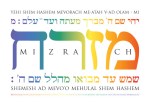
Guest post on Books & Blintzes

I have a guest post up today on Rabbi Deborah Miller’s blog Books and Blintzes.

Guest Contributor – Erica Schultz Yakovetz, Calligrapher and Graphic Designer

(I’m pleased to note that I have the first-and-so-far-only post under the category “Visual Arts > Graphic Design“.)

Jewish artist friends: She’s looking for additional guest contributors. If you would like to share a little bit about your work, go get in touch.

SCOTUS Angels update: Nonviolent (gun-free) edition

At last writing, I had recently released the original SCOTUS Angels design and promised (after many inquiries) to create a nonviolent, gun-free version.

Things that have happened since then:

  • On March 8, Amy Hagstrom Miller, founder/president of Whole Woman’s Health and lead plaintiff on Whole Woman’s Health v. Hellerstedt, contacted me on Facebook to ask if I would consider directing the proceeds toward the Center for Reproductive Rights (the nonprofit law firm representing WWH to the Supreme Court), rather than my go-to of Planned Parenthood. I was happy to agree to this idea. Ten percent of the royalties from this design (both versions) will now benefit the Center for Reproductive Rights.
  • Also on March 8, Zazzle pulled down every product using the first design, on the grounds of copyright (really trademark) infringement. Alas!
  • On March 12, I released the gun-free version. In this edition, justice is being served with the tools of law (symbolized by gavels, scales, and books) rather than with weapons. I posted both designs on an art site called Society6, about which I had heard good things. However, their product selection is more limited than Zazzle’s (no bumper stickers! no plus sizes!), so I also went back and posted the new design on Zazzle. So far, it’s remained up with no copyright issues.
  • Tangentially, but not for nothing: On March 16, President Obama nominated Merrick Garland to fill the SCOTUS vacancy. (Side note: if approved, his appointment would increase the count of Jews on the Court to 4 out of 9, joining Justices Ginsburg, Breyer, and Kagan.) Dear Senate Judiciary Committee: Approve or reject him as you see fit, but please, #DoYourJob and hold the hearings.

Anyway. Shop the collections:


New project: SCOTUS Angels

Hi. This is Erica. Apparently I won the Internet this weekend, with a little Photoshop riff on a classic tableau.

“Once upon a time there were three brilliant women who went to the Supreme Court. Two Jewish, the other Latina. And now they work for me. My name is Social Justice.”

Posted by Erica Schultz Yakovetz on Saturday, March 5, 2016

Inspired by Dahlia Lithwick’s March 2 Slate article on Whole Woman’s Health v. Hellerstedt, my friend Laurie asked for a T-shirt of Justices Ginsburg, Kagan and Sotomayor in a Charlie’s Angels pose. Saturday night, I released this:

This slideshow requires JavaScript.

That’s the Notorious RBG in the center, with Elena Kagan at left and Sonia Sotomayor at right. The white jabots are based on the real versions sported by each of these amazing women.

Now you, too, can have that T-shirt, thanks to Zazzle. There are different variations for different background colors, so the product line is getting a little complex. I’m curating the full set at this link: SCOTUS Angels Collection.

I’m pledging 10% of my royalties to Planned Parenthood. UPDATE, 3/8/16: Amy Hagstrom Miller, the lead plaintiff in Whole Women’s Health v. Hellerstedt, reached out to me today to ask if the proceeds could instead support the Center for Reproductive Rights (the nonprofit law firm representing WWH for this case). So, while the first $50 based on sales to date will still go to Planned Parenthood (my go-to, along with Medical Students for Choice and the ACLU, for my regular charitable support), I am happy to direct 10% of the future proceeds to the Center. Thank you, Amy, for your activism! And Happy International Women’s Day!

And after many requests, YES, I will be creating a nonviolent (gun-free) version in the near future. Gavels, law book, scales of justice. Something. Watch this space.

New art piece: If I Am Not For Myself, Who Will Be For Me? (2015 Edition)

I’m pleased to report that my Etsy shop, Schultz Yakovetz Judaica, is doing well. Not “quit my day job” well or anything, but I’ve literally sold more art in the last six months than I had in all the previous years—total—of selling via my website. (For that matter, it seems to have raised the profile of my own site, since a few of those recent sales came directly through my site rather than the Etsy shop. And even that was a statistically significant uptick.)

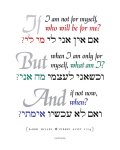
ifiam_originalMost recently, I happened to see a few orders in a row for one of my earliest pieces, a setting of Rabbi Hillel’s famous aphorism in Pirkei Avot:

If I am not for myself, who will be for me?
But when I am only for myself, what am I?
And if not now, when?
(Pirkei Avot 1:14)

Fun fact: I first created this piece in a handmade version as a gift for my dad back in 1994. The typeset version was designed some years afterward, but no later than 2001.

In other words, it’s gotten a little dated… especially as typographic decorative art has really come into fashion over the last few years (everywhere from Etsy to CB2 to Target) with a more contemporary aesthetic.

Looking at it with fresh eyes, I decided that it was really time for an update. So I created a new version.

This slideshow requires JavaScript.

While I was at it, I posted a downloadable version so that buyers can print their own copy (at any desired size) locally, rather than have me ship them an unframed print. One download includes PDFs of all three pieces.

Carpe diem!

New for 2015: I’m in a book!

Last month, I received an email inquiry from a photographer named Susan Ressler, formerly of Indiana (she is Professor Emerita of Visual and Performing Arts at Purdue University) and now of New Mexico. elements

Susan was preparing to self-publish a book of her fine art photography from a recent trip to Israel, organized (as it happened) into sections based on the elements: Air, Fire, Water, and Earth. She had come across my 2007 piece Elements: The Holy Cities and wanted to include it in the introduction to her book, as a way of setting the stage!

Her completed book, Understanding Israel (subtitle: “Jaffa is More than Oranges”), is now live on a print-on-demand site called Blurb. It’s available in two trim sizes: 8×10 ($45.99) or the more luxurious 11×13 ($99.95), both in a dramatic landscape format. If you click on the title above, you can browse through the entire book. For the curious, my contribution is on page 10 :-) but the rest is well worth a look.

Below is the official Blurb “badge” for the book:

Understanding Israel (8x10
Understanding …
Jaffa is More than…
By Susan Rebecca Ressler
Photo book

 
(And also, since apparently this is my first post in the new year: Happy 2015!)

New art piece: To Everything There Is A Season

Today is Rosh Chodesh Elul (which means only one month to Rosh Hashanah). In honor of the new Hebrew month, I’m debuting a new art piece!

As a young teenager, I was deeply into the music of the 1960s, and I still remember getting goosebumps the first time I heard the Byrds’ 1965 hit recording of Pete Seeger’s “Turn! Turn! Turn! (To Everything There Is a Season)”.

I knew it was taken from a passage in the Book of Ecclesiastes, though I didn’t know much more about it than that. Much later, I experienced Ecclesiastes as the Hebrew scroll of Kohelet, which is traditionally ascribed (like the book of Proverbs, or Mishlei ) to King Solomon, and in many Jewish communities is read aloud in its entirety at Shabbat synagogue services during the fall holiday of Sukkot.

A couple of years ago, at a friend’s house, I saw a framed calligraphy piece based on this same passage, Ecclesiastes 3:1-8. That inspired me to want to do a version of my own.

The primary motif I had in mind was to set the English phrases as a sine wave or a helix, winding around the structure of the Hebrew. The above-and-below undulation would convey the duality in each of the pairings. Each Hebrew phrase is color-matched with its English equivalent to create a visual connection between the two levels. I chose to invert the Hebrew in these layers so that the text flow of both languages could run in the same clockwise direction — another way to echo the “wheel of time” feeling of the passage.

Ultimately, I arranged the text in a mandala of four nesting circles. The outermost circle is formed from the opening verse, which provides the conceptual frame for the whole passage. The second layer contains eight pairings, the third layer five pairings, and the last pairing forms the final circle with “peace” at its center… driving the whole composition, like Pete Seeger’s adaptation, toward an optimistic goal at its core.

One note on the translation: The well-known King James Version translates the second half of verse 1 as “and a time to every purpose under the heaven”. The Hebrew word used there, however, is cheifetz, which in other contexts is always rendered as “please” or “enjoy”. (Compare to Psalm 115:3, V’elokeinu ba-shamayim; kol asher chafetz asah. “Our God is in the heavens; He does whatever He pleases.”) Thus, some English translations give it as “to every delight” or “pleasure under the heavens”. Many other translations simply say “event”, “matter” or “activity”. I wanted to find a word that conveyed the semantic direction of “pleasing” without categorizing killing and destroying as “delights”, and settled on “to every impulse under the heavens.” I also tried to preserve the distinctions in the Hebrew between “a time to [verb]” and “a time of [noun]”.

This slideshow requires JavaScript.

I created Version I using the classical Roman-style font Trajan for all of the English text, for a smooth and formal look. However, then I wanted to try to bring out the (literal) texture of the passage with a little more contrast, so I experimented with applying a calligraphic italic hand (a font called Aquiline) to accent the changing keywords in each English phrase. This resulted in Version II.

Both pieces are now available in my Etsy shop, along with a hi-res PDF download that includes both versions in case you prefer to print your own.

Which version do you think works best? Let me know in comments.

Chodesh tov!

How I make art, Part 1: Resources for Hebrew text

This week, I’ve been working on a new Judaica art piece, which I look forward to releasing next week! But before I get there, I wanted to talk about my process for making art out of text in Hebrew and English.

It starts where everything starts — with an idea. Some words catch my eye and fire my imagination. Most often, it’s either a Biblical text or a passage from the siddur, the Jewish prayerbook. (Frequently, it’s both, as Biblical quotations make up a significant portion of the wording of our formal prayers.) Occasionally, it’s a quote from the Talmud, about which more below.

But how do I get going from there? First, I go to the Internet!

… Why not start on my own bookshelf? I own numerous Bibles in both Hebrew and English (one of my favorite translations, incidentally, is Everett Fox‘s Five Books of Moses, a.k.a. the Schocken Bible). But here’s Confession #1: I’m not so strong on chapter and verse. So I start by doing a Google search for the English phrasing, in order to locate the verse I’m thinking of.

From there, I look up the Hebrew. Mechon Mamre maintains an excellent complete Hebrew-English online Bible, featuring the well-reputed standard English translation by the Jewish Publication Society (JPS). I will usually go here to copy and paste entire passages. Note, though, that they provide “pointed” text, with the nekudot: vowel marks and other punctuation that are positioned around the actual letters (or, in the words of psycholinguist Dorit Ravid, “diacritics ancillary to consonantal graphemes”).* This notation is essential for study purposes, but I generally go on to strip out the nikkud, because I prefer to use just the un-pointed letters in my artwork.

* However, the Ancillary Diacritics is totally my new band name.

My next stop is, perhaps surprisingly, a Christian Bible site, one called Blue Letter Bible. While I tend to steer clear of Christian-sponsored sites, this one offers a spectacular feature that I haven’t found elsewhere: a word-by-word breakdown of the original Hebrew, as well as the Greek from the Septuagint, for every single verse of the Old Testament.

[Blue Letter Bible tools screenshot]

The language tools at Blue Letter Bible. Careful observers will pick up a clue as to the forthcoming new art piece.

My own Hebrew skills are normally sufficient to match up the corresponding words from an English translation; in fact, this is an important element in my artwork, where I frequently color-code specific words or phrases to create explicit visual connections between the texts. But sometimes I feel like the English in front of me doesn’t quite capture the nuance I’m getting from the Hebrew. When I want to refine the translation I’m including in the piece, it can be amazingly helpful to see a range of English translations side-by-side, or to click through to the Strong’s Concordance entry to see how the same word has been interpreted in different contexts. Plus, they provide a box to toggle the “vowel points” (the aforementioned nekudot) on or off, so I can copy a whole verse with just the unpointed letters. Priceless.

Now, what if I am researching a Talmud quotation? Certain sections are easy to find in translation, like the tractate of Avot, better known as Pirkei Avot, or in English as “The Ethics of the Fathers”, which is reproduced in its entirety in most traditional prayerbooks. Often, however, I will see delightful quotes attributed solely to “The Talmud”… which may be technically accurate, but not very helpful! Google is my friend here again. Sometimes it turns out that quotes attributed to “The Talmud” (such as this one, identified here) actually come from Midrash Rabbah, which is a fantastic (and often fantastical) body of interpretive commentaries, but not part of the Talmud.

Once I can get a specific citation, I can look up the Hebrew in Mechon Mamre’s online Talmud Bavli (the “Babylonian” Talmud that is the version commonly studied). Some chapters are available in English at Halakhah.com, at Sacred Texts, and at the Jewish Virtual Library. If I’m looking for Midrash Rabbah, there’s a complete online Hebrew edition at Tsel Harim.

For Hebrew text from the prayerbook, I am more likely to turn to my actual bookshelf. However, there are several useful Web resources, such as the Online Siddur, the Open Siddur Project, and the Free Siddur Project.

There are many more great collections of links and scholarly resources at sites like the following:

One last technical note: I create my artwork in Adobe InDesign. Now, if I copy a line of Hebrew text from a web page, it is almost certainly in Unicode, which the browser knows to render right-to-left… but InDesign pastes in the character sequence from left to right. Because here’s Confession #2: I don’t actually use it to handle Hebrew properly. Now that I’ve upgraded to Creative Suite 6, its World-Ready Composer gives some built-in support for right-to-left sequencing at either the paragraph or character level… but the way it behaves still isn’t very intuitive for me, and I get frustrated after just a few minutes. It’s actually easier for me to cheat with an intermediate step: reversing the string in order to make it come out correctly. On a few old projects, I did this by hand (!), but these days I turn once again to the magic of the Internet, where there are handy web-based utilities for this purpose.

  • Reverse a String Online was my longtime quick-and-dirty favorite for single lines.
  • Text Mechanic’s “Reverse Text Generator” offers an additional option called “Flip Text”, which reverses each line (or technically paragraph), but keeps the lines themselves in the correct top-to-bottom sequence — just what I need for longer sections.

Once I’ve got all my text in place, in Hebrew and English, that’s my raw material. Only then can I start to play with it to create art. But that’s a totally separate process that I will try to address in another, less technical — and probably shorter! — post.

Shabbat shalom!
My new Etsy shop: Schultz Yakovetz Judaica

Recently, I took the plunge and did something I’ve been thinking about for ages: open a storefront for my Judaica artwork on Etsy.

Check it out! Visit now: www.etsy.com/shop/SchultzYakovetz

SYJbanner

For anyone not familiar with Etsy:

Etsy is a marketplace for crafters, artists, and collectors to sell their handmade creations, vintage goods, and crafting supplies. Etsy celebrates individual creativity in design and craftsmanship by connecting unique people, stories, and items in a playful and meaningful way. —from the site

So far, my storefront features a subset of the art prints available on my main Judaica site. Here’s a quick sample:

In the coming weeks, look out for:

  • Downloadable hi-res digital files (so you can print a piece for yourself and save on shipping!)
  • Photos of the framed finished pieces (so you can see how awesome they’ll look on your wall)
  • Holiday cards (remember, Rosh Hashanah 5776 starts Wednesday, September 24)
  • My top ketubah designs available to customize
  • New art pieces exclusive to Etsy

Happy shopping… and shabbat shalom!

Because this is still a design blog: Who By Fire

I’ve occasionally tried my hand at creating holiday cards, but never anything particularly inspired, somehow.

Then during Rosh Hashanah services this year, I managed to remember that the Thing I Do is play around with text, especially Biblical or liturgical text… and there’s no shortage of great material in the High Holiday liturgy. Which excited me, even if it results in a bit of a departure from your basic apples-and-honey “good and sweet year” greeting card motif.

So here’s the first one:

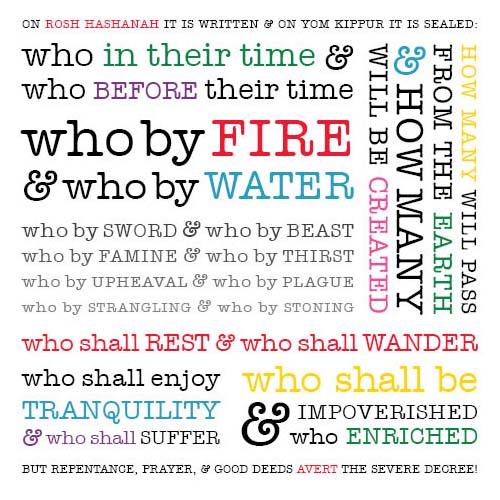
On Rosh Hashanah it is written, and on Yom Kippur it is sealed...

This famous liturgical passage is from the central U’netaneh Tokef section of the Rosh Hashanah Musaf prayer service. Click to enlarge.

I have a few more passages still in mind to work up. Next year I intend to actually get some of them printed up in time to use for the holiday… so I made sure to use up the last few mundane ones in my stash this year.

Edited to add (2015): Buy it on Zazzle!

Ketivah v’chatimah tovah: May you all be written and sealed for a good year.

New ketubah design: Flames

Friends in the Philadelphia area invited me several months ago to create the ketubah for their wedding, taking place today. I’m sadly missing the wedding itself, as I am away on vacation with my mom (this post is appearing through the magic of pre-scheduled posting; thanks, WordPress!), but I was excited to be able to play a role in their special day nevertheless.

Today is Lag Ba’Omer, the 33rd day of the seven-week “omer” period between the Jewish holidays of Passover and Shavuot. Sefirat ha-Omer is a period of semi-mourning in which a variety of joyful activities are customarily proscribed, including listening to live music, buying new clothes, cutting one’s hair (!), and getting married. However, the 33rd day of this period is observed as a minor festival, with a temporary lifting of those prohibitions… making it a very popular date for Jewish weddings, particularly when it falls out, as this year, on a Sunday.

Weddings aside, Lag Ba’Omer is typically associated with outdoor celebrations, and especially with bonfires. So when it came time to ponder artistic themes for this ketubah, I suggested fire, and the idea immediately touched off, well, sparks.

ketubah

A bonfire-themed ketubah for a Lag Ba’Omer wedding.

In this all-text design, the two primary flames are the ketubah text itself: standard Orthodox Aramaic incorporating the Lieberman clause, and an accompanying English rendition (not, mind you, a translation; the actual standard legal text is highly technical and nothing so poetic). The additional decorative “sparks” rising up around the flames are verses from Song of Songs (2:10, 2:14, and 6:3). Producing this piece digitally meant that I could apply a gradient color scheme to enhance the flame effect—something we could never have achieved with hand-lettering.

The finished piece is 16×20. It was output by my go-to colleague for digital imaging, Jim Paradis of Baldwin Hill Art & Framing in Natick, MA, as an archival-quality giclée art print on smooth art paper. The entire design and approval process took just over five weeks, and the final print was shipped overnight with a week to go before the wedding.

Mazal tov, Lawrence and Ellyn!