Shabbat HaGadol: The Big Shabbos

Passover is a week away? Already?? It always seems to come as a surprise, but not if you’ve been paying attention to the subtle calendar clues in our tradition.

The two months leading up to Passover include four special Shabbats that include additional maftir Torah readings from a second Torah scroll:

  • Shabbat Shekalim, the Shabbat immediately prior to (or falling on) Rosh Chodesh Adar; the maftir reading, Exodus 30:11-16, describes the half-shekel census taken in the wilderness.
  • Shabbat Zakhor, the Shabbat before Purim; the maftir reading, Deuteronomy 25:17-19, commands us to remember (zakhor) the treachery of Amalek and to simultaneously blot out his name from our memory, as we will shortly do on Purim.
  • Shabbat Parah, one to two weeks prior to Rosh Chodesh Nisan; the maftir reading, Numbers 19:1-22, fondly known as the “Holy Cow” Parshah, discusses the arcane ritual of the red heifer (parah adumah).
  • Shabbat HaChodesh, the Shabbat immediately prior to (or falling on) Rosh Chodesh Nisan; the maftir reading, Exodus 12:1-20, starts with the line “This month (ha-chodesh ha-zeh) shall be for you the beginning of the months, it shall be for you the first of the months of the year.” This is when you know you have only 2+ weeks left until Passover and it’s time to start screaming… er, cleaning. This was a week ago yesterday. (Yesterday was plain old Parshat Vayikra, the first parshah in the book of Leviticus.)

This coming Shabbat, the one that falls immediately prior to Passover, isn’t one of those four, but it still gets a special haftarah portion and hence a special name: Shabbat HaGadol, literally “The Great Shabbat”, or as my Tremont St. Shul crowd liked to say, “The Big Shabbos”. It’s not super common for Shabbat HaGadol to literally fall on the eve of Passover, but anytime you have a Saturday night first seder, you’ve got yourself a Shabbat HaGadol double header.

The Haftarah for Shabbat HaGadol is Malachi 3:4-24, and the day takes its name from verse 23: “Lo, I will send the prophet Elijah to you before the coming of the awesome (ha-gadol), fearful day of the Lord”. I was commissioned some years ago to create a piece from this haftarah as a bat mitzvah gift. The actual eponymous verse didn’t grab me, and it took a little digging to find a passage that would be both uplifting and memorable, but I settled on verses 16-17:
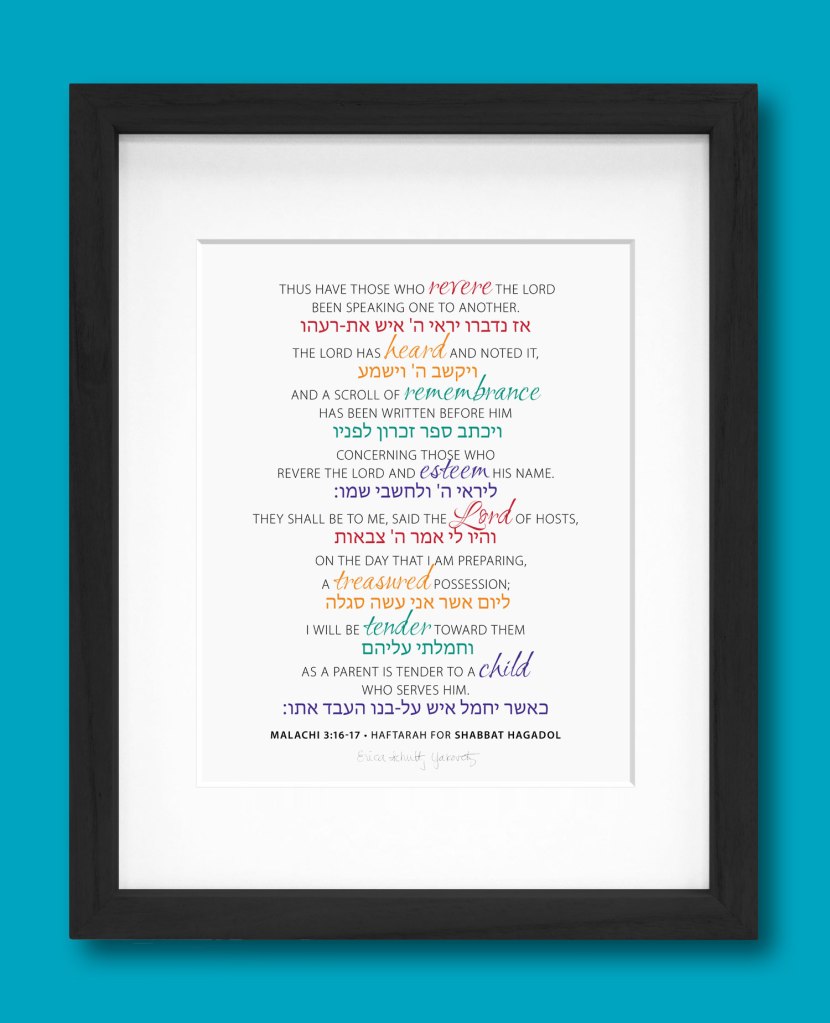
Thus have those who revere the Lord been speaking one to another. The Lord has heard and noted it, and a scroll of remembrance has been written before Him concerning those who revere the Lord and esteem His name.
They shall be to me, said the Lord of Hosts, on the day that I am preparing, a treasured possession; I will be tender toward them as a parent is tender to a child who serves him.
Malachi 3:16-17

Interestingly, this week’s Torah portion is Tzav, the second parshah in the book of Vayikra (Leviticus). The designated haftarah portion officially paired with Tzav is from the book of Jeremiah (7:21-8:3, 9:22-23). However, because Tzav so frequently falls out on one of the aforementioned five special Shabbats, the “standard” haftarah is very rarely read. It was read in 2022, but it won’t be read again until 2043! I have an art piece for this as well:

Thus says the Lord: Let not the wise glory in their wisdom; and let not the strong glory in their strength; let not the wealthy glory in their wealth.
But only in this should they glory: in knowing and understanding Me, that I am the Lord who does kindness, justice and righteousness in the land, for in these I delight, says the Lord.
Jeremiah 9:23-24

Let’s not forget to bring that energy into this week, as well.

Wishing everyone a sweet and kosher Passover!
Dvar Torah for Matot-Masei 5782

This week we close out the book of Bamidbar with a double parshah, Matot, meaning “Tribes”, and Masei, meaning “Travels” or “Trips” – this is the same word found in the name of our congregational religious school that we call Masa B’Yachad, or “Journey Together”.

This is a pretty technical parsha, and while there are some action scenes, there’s also a lot of material that doesn’t really support the narrative structure. Matot opens with some legal discussion about vows (specifically by women, and when they do and don’t count); and it proceeds to a Netflix-worthy scene of the Israelites’ slaughter of their enemies. But then it goes into this extremely detailed accounting of the spoils of the battle, how much was allocated to each tribe, and exactly what percentage was levied off to support the Levi’im. This is the parsha that makes you ask, “what would 675,000 sheep actually look like, and how would you possibly go about counting them all??” …lest we forget that we are, after all, nearing the end of the book of Numbers.

Continue reading

Tu BiShvat and the Kabbalistic Four Worlds

(No, it’s not a new Harry Potter knockoff series, although couldn’t you just see that?)

tl;dr It’s the New Year of the Trees, so join me tonight at 6pm CST / 7pm EST for a virtual Tu B’Shvat seder with the Tremont St. Shul. Email or PM me for the Zoom info. BYOF – Bring Your Own Fruit!

Some 20 years ago, I was running the 20s&30s young adult group at my synagogue, Temple Beth Shalom of Cambridge (MA), a.k.a. the Tremont Street Shul. I believe the first time we ran a formal Tu B’Shvat seder was in 2001, because I stayed up all night cobbling together a seder packet, which you can still download today from my website. It was a popular event year after year, with fruit platters, red and white wine, candles and eucalyptus branches on the tables. I’ve always had a fondness since then for Tu B’Shevat, the New Year of the Trees.

In 2020 and 2021, as we all became Zoom-based lifeforms in the wake of the Covid pandemic, synagogues (like most organizations) began searching for ways to build virtual community. In the spring of 2021, TBS had the great idea to run a virtual Tu Bishvat program and send out fruit baskets to their members, and they asked me to run an abridged version of the seder. It was really an honor to participate and a joy to see so many of my old chevre.

It went over well enough that they’re doing it again for 2022, tonight at 7pm EST (6pm CST). It’s free and open to the public, so contact me if you’d like the Zoom information, or sign up here.

Below are my notes from last year, since I had my script mostly written out. This year we’ll try to make it a little more focused and in-depth, but this is good background for anyone.

Continue reading

The Jewish Advocate interviews me

My writer friend Michael A. Burstein sometimes writes for The Jewish Advocate, which is the local Jewish community newspaper in Boston. He is also a regular attendee of Arisia, so he pitched an article to the Advocate regarding the Friday night davening and the new siddur, and he interviewed me for it.

Observant Jews ‘daven’ long, prosper at area sci-fi con

The article made the front page of this week’s paper (!), but like all their digital content, it’s behind a paywall. (Boston locals please note: If you’re not an Advocate subscriber, you can still pick up an individual copy at the Israel Book Shop in Brookline… if the snow emergency ever ends!) So rather than the article itself, I give you the (slightly edited) text of my interview answers instead.

Continue reading

Free Printable Friday Night Prayerbook (Condensed Edition)

This past weekend was the Arisia science fiction convention, which is put on each January by several hundred of my closest friends in Boston, MA. I attended almost every Arisia from 1999 to 2014 (after which I moved back to the Midwest). In 2006, since all my geeky shul friends were attending the convention anyway, I started organizing a Friday night Kabbalat Shabbat service at the convention hotel. Those of us who were on the synagogue board borrowed a large (and heavy!) crate of assorted prayerbooks from Temple Beth Shalom of Cambridge every year to make the service happen.

This service, I am happy to say, is still going on, organized by Terri Ash (of Geek Calligraphy) and her family. But for 2017, Terri wanted a pamphlet-style siddur containing only the prayers for Friday night, that could be stored from year to year just for Arisia. But we weren’t aware of any existing siddur that fit our needs, so, what do we do? Build our own (based on the extensive resources available at the groundbreaking OpenSiddur.org website). She asked “Who wants to help make this happen?” and of course I said “Here I am!”  Continue reading

New art piece: To Everything There Is A Season

Today is Rosh Chodesh Elul (which means only one month to Rosh Hashanah). In honor of the new Hebrew month, I’m debuting a new art piece!

As a young teenager, I was deeply into the music of the 1960s, and I still remember getting goosebumps the first time I heard the Byrds’ 1965 hit recording of Pete Seeger’s “Turn! Turn! Turn! (To Everything There Is a Season)”.

I knew it was taken from a passage in the Book of Ecclesiastes, though I didn’t know much more about it than that. Much later, I experienced Ecclesiastes as the Hebrew scroll of Kohelet, which is traditionally ascribed (like the book of Proverbs, or Mishlei ) to King Solomon, and in many Jewish communities is read aloud in its entirety at Shabbat synagogue services during the fall holiday of Sukkot.

A couple of years ago, at a friend’s house, I saw a framed calligraphy piece based on this same passage, Ecclesiastes 3:1-8. That inspired me to want to do a version of my own.

The primary motif I had in mind was to set the English phrases as a sine wave or a helix, winding around the structure of the Hebrew. The above-and-below undulation would convey the duality in each of the pairings. Each Hebrew phrase is color-matched with its English equivalent to create a visual connection between the two levels. I chose to invert the Hebrew in these layers so that the text flow of both languages could run in the same clockwise direction — another way to echo the “wheel of time” feeling of the passage.

Ultimately, I arranged the text in a mandala of four nesting circles. The outermost circle is formed from the opening verse, which provides the conceptual frame for the whole passage. The second layer contains eight pairings, the third layer five pairings, and the last pairing forms the final circle with “peace” at its center… driving the whole composition, like Pete Seeger’s adaptation, toward an optimistic goal at its core.

One note on the translation: The well-known King James Version translates the second half of verse 1 as “and a time to every purpose under the heaven”. The Hebrew word used there, however, is cheifetz, which in other contexts is always rendered as “please” or “enjoy”. (Compare to Psalm 115:3, V’elokeinu ba-shamayim; kol asher chafetz asah. “Our God is in the heavens; He does whatever He pleases.”) Thus, some English translations give it as “to every delight” or “pleasure under the heavens”. Many other translations simply say “event”, “matter” or “activity”. I wanted to find a word that conveyed the semantic direction of “pleasing” without categorizing killing and destroying as “delights”, and settled on “to every impulse under the heavens.” I also tried to preserve the distinctions in the Hebrew between “a time to [verb]” and “a time of [noun]”.

This slideshow requires JavaScript.

I created Version I using the classical Roman-style font Trajan for all of the English text, for a smooth and formal look. However, then I wanted to try to bring out the (literal) texture of the passage with a little more contrast, so I experimented with applying a calligraphic italic hand (a font called Aquiline) to accent the changing keywords in each English phrase. This resulted in Version II.

Both pieces are now available in my Etsy shop, along with a hi-res PDF download that includes both versions in case you prefer to print your own.

Which version do you think works best? Let me know in comments.

Chodesh tov!

Because this is still a design blog: Who By Fire

I’ve occasionally tried my hand at creating holiday cards, but never anything particularly inspired, somehow.

Then during Rosh Hashanah services this year, I managed to remember that the Thing I Do is play around with text, especially Biblical or liturgical text… and there’s no shortage of great material in the High Holiday liturgy. Which excited me, even if it results in a bit of a departure from your basic apples-and-honey “good and sweet year” greeting card motif.

So here’s the first one:

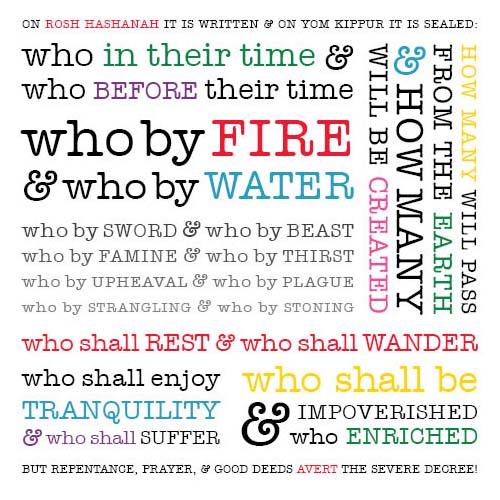
On Rosh Hashanah it is written, and on Yom Kippur it is sealed...

This famous liturgical passage is from the central U’netaneh Tokef section of the Rosh Hashanah Musaf prayer service. Click to enlarge.

I have a few more passages still in mind to work up. Next year I intend to actually get some of them printed up in time to use for the holiday… so I made sure to use up the last few mundane ones in my stash this year.

Edited to add (2015): Buy it on Zazzle!

Ketivah v’chatimah tovah: May you all be written and sealed for a good year.

Where you can find me for the High Holidays

One of my fellow members at Town & Village Synagogue in downtown Manhattan is Rabbi Judith Hauptman, who is on the faculty at JTS. I first met her over Rosh Hashanah lunch this time last year. For the past several years, Rabbi Hauptman has run a free, public community young adult High Holiday congregation under the name of Ohel Ayalah (“the tent of Ayalah,” named for her mother z”l, the inspiration for this hospitable service). Ohel Ayalah also runs a community young adult Passover seder, which I happened to attend this past April when I needed a place for 2nd-night seder, and I was impressed how they managed to do what felt like a full and complete traditional seder liturgy, blend in enough time for socializing, and still get us out of there at the stroke of 10pm.

One week earlier this summer, I attended T&V’s regular Friday night service, which as a rule is incredibly rich with powerful singing (thanks largely to the amazing Cantor Shayna Postman, and whichever of my fellow choirmates happen to be in the congregation on any given week). After the service, Rabbi Hauptman came up to me and said “How would you like to come daven with me for the High Holidays?”

“Um,” I said, “I’m not sure how useful I can really be to you on that!” I’m not, in truth, very well versed in actual liturgy for anything beyond the Friday night service, Torah service, and occasional Shabbat Musaf. But she has (as I knew) a regular cantor, Josh Gorfinkle, who does the liturgical heavy lifting, and a couple of additional/backup service leaders. In particular, she said, she was basically just looking for someone to reinforce the singing up front on a microphone and thereby add to the overall ruach of the service. That, I said, is something I can do. Even if it means I have to negotiate splitting my time with the choir at T&V, where I would otherwise be spending all of the holidays.

The upshot is that I’ll be with Ohel Ayalah’s Manhattan service for the first evening and day of Rosh Hashanah and for Kol Nidrei. And in addition to harmonizing throughout the services, and reading the Haftarah (the story of Chana, which is my Hebrew name, so that’s awesome), she asked me to sing one of the three repetitions of the Kol Nidrei prayer. I am deeply honored… and only a little terrified. It turns out that I have at least some version of Kol Nidrei internalized from the many years I spent in the professional High Holiday backup choir in Swampscott/Marblehead (starting in 1997 at Temple Israel, which eventually became Congregation Shirat HaYam). Of course, the arrangement in my head is a choral monstrosity for cantor, four-part choir, and possibly organ… but if I sing through some combination of the lines I remember, with enough conviction and kavannah, it seems to hang together well enough.

Rabbi Hauptman offered to lend me a kittel, since she wants all of us to wear them on the bimah. But the Sunday before last, I went up to West Side Judaica on 88th & Broadway and bought one of my own. Amusingly, the nice lady at the register wished me mazal tov… because these are—like the tallit—traditionally considered a men’s garment, and worn particularly for weddings, as well as High Holidays and Passover seders. So, y’know, what else does it mean when a woman of marriageable age is buying one? (Granted, the last time I bought one, that was what it was for, but that’s another story.) Happily, the gentleman who assisted me in finding one had not batted an eyelash when I asserted that it was for myself and patiently helped me sort through and try on all the sizes of the three or four styles they had. I purposely picked out the very most girly-looking one: all pintucks and lace edges. It’s like the world’s prettiest lab coat. I am excited.

I think it’s going to be a good year.

And if you want to come and daven with me, they’re still accepting walk-ins at the Prince George Ballroom (15 E 27 St., between 5th and Madison), tomorrow night at 6:45pm and Thursday morning at 9am. L’shanah tovah u’metukah!