Passover is a week away? Already?? It always seems to come as a surprise, but not if you’ve been paying attention to the subtle calendar clues in our tradition.
The two months leading up to Passover include four special Shabbats that include additional maftir Torah readings from a second Torah scroll:
- Shabbat Shekalim, the Shabbat immediately prior to (or falling on) Rosh Chodesh Adar; the maftir reading, Exodus 30:11-16, describes the half-shekel census taken in the wilderness.
- Shabbat Zakhor, the Shabbat before Purim; the maftir reading, Deuteronomy 25:17-19, commands us to remember (zakhor) the treachery of Amalek and to simultaneously blot out his name from our memory, as we will shortly do on Purim.
- Shabbat Parah, one to two weeks prior to Rosh Chodesh Nisan; the maftir reading, Numbers 19:1-22, fondly known as the “Holy Cow” Parshah, discusses the arcane ritual of the red heifer (parah adumah).
- Shabbat HaChodesh, the Shabbat immediately prior to (or falling on) Rosh Chodesh Nisan; the maftir reading, Exodus 12:1-20, starts with the line “This month (ha-chodesh ha-zeh) shall be for you the beginning of the months, it shall be for you the first of the months of the year.” This is when you know you have only 2+ weeks left until Passover and it’s time to start screaming… er, cleaning. This was a week ago yesterday. (Yesterday was plain old Parshat Vayikra, the first parshah in the book of Leviticus.)
This coming Shabbat, the one that falls immediately prior to Passover, isn’t one of those four, but it still gets a special haftarah portion and hence a special name: Shabbat HaGadol, literally “The Great Shabbat”, or as my Tremont St. Shul crowd liked to say, “The Big Shabbos”. It’s not super common for Shabbat HaGadol to literally fall on the eve of Passover, but anytime you have a Saturday night first seder, you’ve got yourself a Shabbat HaGadol double header.
The Haftarah for Shabbat HaGadol is Malachi 3:4-24, and the day takes its name from verse 23: “Lo, I will send the prophet Elijah to you before the coming of the awesome (ha-gadol), fearful day of the Lord”. I was commissioned some years ago to create a piece from this haftarah as a bat mitzvah gift. The actual eponymous verse didn’t grab me, and it took a little digging to find a passage that would be both uplifting and memorable, but I settled on verses 16-17:
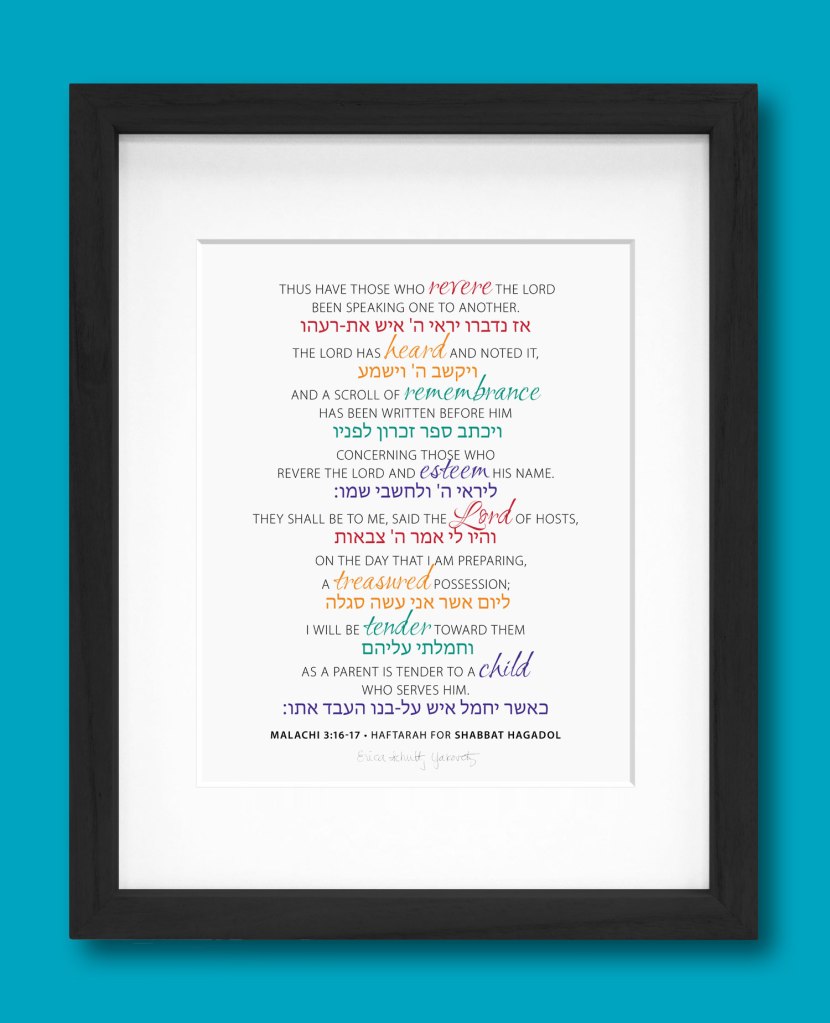
Thus have those who revere the Lord been speaking one to another. The Lord has heard and noted it, and a scroll of remembrance has been written before Him concerning those who revere the Lord and esteem His name.
They shall be to me, said the Lord of Hosts, on the day that I am preparing, a treasured possession; I will be tender toward them as a parent is tender to a child who serves him.
—Malachi 3:16-17
Interestingly, this week’s Torah portion is Tzav, the second parshah in the book of Vayikra (Leviticus). The designated haftarah portion officially paired with Tzav is from the book of Jeremiah (7:21-8:3, 9:22-23). However, because Tzav so frequently falls out on one of the aforementioned five special Shabbats, the “standard” haftarah is very rarely read. It was read in 2022, but it won’t be read again until 2043! I have an art piece for this as well:

Thus says the Lord: Let not the wise glory in their wisdom; and let not the strong glory in their strength; let not the wealthy glory in their wealth.
But only in this should they glory: in knowing and understanding Me, that I am the Lord who does kindness, justice and righteousness in the land, for in these I delight, says the Lord.
—Jeremiah 9:23-24
Let’s not forget to bring that energy into this week, as well.
Wishing everyone a sweet and kosher Passover!


 Erica Schultz Yakovetz